
DEFICIENCY RESPONSE
By the Ironsmith Fire Engineering Team · Memphis, Nashville, Jacksonville AR, Orlando, Houston
A failed fire inspection doesn’t mean your building is closing. It means an inspector documented conditions that fall short of the standard, and you now own a clock you didn’t set. The work is to sort those findings by how dangerous they are, protect the building from anything that leaves it unprotected right now, correct the rest in priority order with qualified people, and get it documented and re-verified. Sorted correctly, most failed inspections are a scheduling problem. Sorted incorrectly, they become a liability problem.
Quick facts
- A deficiency and an impairment aren’t the same thing. A deficiency is a condition that falls short of the standard. An impairment means a system, or part of one, is out of service and may not work in a fire. Impairments get acted on the same day. Deficiencies get scheduled.
- NFPA 25 sorts deficiencies into critical and noncritical. The split arrived in the 2011 edition. A critical deficiency can materially affect whether the system performs in a fire. A noncritical one still has to be corrected, but it doesn’t carry that consequence.
- No national standard sets the correction deadline. No model code and no NFPA standard sets a universal window for fixing deficiencies. The authority having jurisdiction sets it. Get yours in writing.
- A system out of service forces a decision under the fire code. Under International Fire Code section 901.7, when a required fire protection system is out of service, the fire department and the code official are notified immediately, and the building is either evacuated or placed on an approved fire watch.
- Correcting the findings is the owner’s job. NFPA 25 places responsibility for maintaining the system, and for correcting deficiencies and impairments, on the property owner or their designated representative.
- Impairments have their own procedure. NFPA 25 Chapter 15 sets out an impairment program: a designated impairment coordinator, a tag on the system, notice to the fire department and the property insurance carrier, and notice again when service is restored.
- Florida runs on a different code than most of the country. The Florida Fire Prevention Code adopts NFPA 1 and NFPA 101 rather than the International Fire Code. Orlando owners should expect the requirements to be framed differently, even where the practical obligation is similar.
After a failed fire inspection, read the report before you call for prices
The instinct after a failed inspection is to get quotes moving. That’s the second step, not the first.
An inspection report isn’t a to-do list of equal items. It’s a mixed document with at least three kinds of findings, and they carry different consequences on different timelines. Send the whole report out for pricing as one scope and you’ll get one number, make one decision about one budget, and the item on page four that needed attention tonight will sit in a queue behind twelve items that could have waited until spring.
So the first move is sorting. It doesn’t take long, and it changes everything that follows.
Step 1: separate impairments from deficiencies
This is the distinction that decides what today looks like.
A deficiency is a condition that doesn’t meet the requirement. A corroded fitting, a painted-over sprinkler head, a missing hydraulic nameplate, storage stacked too close to a head. The system still works. Something about it is wrong.
An impairment is different in kind. It means a system or a portion of it is out of order and may not function in a fire. A closed control valve. A drained dry system. A section shut down for construction. The building isn’t protected in that area, right now, while you read this.
Under NFPA 25, impairments follow their own procedure in Chapter 15 rather than sitting in the general repair queue, because the exposure is immediate. If anything on your report is an impairment, it comes out of the report and becomes today’s work. Everything else can be planned.
If the report doesn’t make the distinction clearly, call the inspecting contractor and ask one question: is anything on this list out of service right now? It’s a short call, and it’s the most important one you’ll make this week.
Step 2: if a system is impaired, protect the building today
An impairment starts a specific sequence, and it’s a short one.
Designate a coordinator. NFPA 25 Chapter 15 calls for an impairment coordinator, a named person responsible for the impairment while it lasts. In practice that’s a facility manager or a designated representative. It’s not whoever happens to be around.
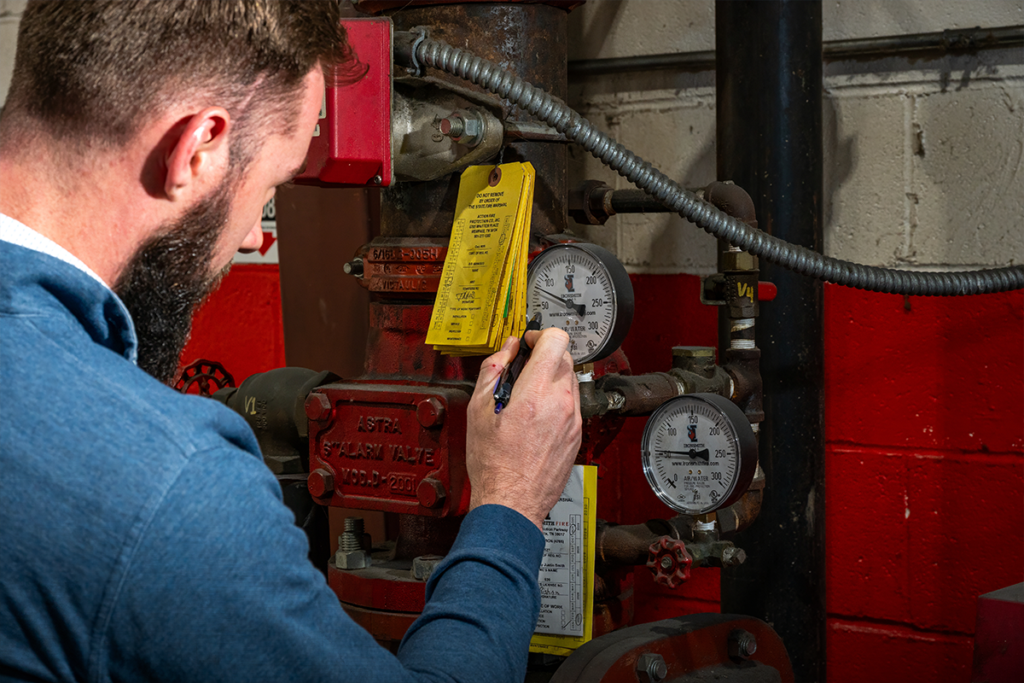
Tag the system. The impairment tag goes where the next person will see it, at the control valve and the fire department connection for a sprinkler system, so nobody assumes protection that isn’t there.
Notify. The fire department or code official, and your property insurance carrier. Both. The insurance call is the easy one to forget, and it’s the one that matters most if something happens while the system is down. Notify them again when the system is restored.
Decide on evacuation or a fire watch. Under IFC 901.7, when a required system is out of service, the building is either evacuated or an approved fire watch is provided. A fire watch isn’t a person sitting at a desk. It’s constant patrol of the affected area by someone whose only job is watching for fire, with a reliable way to call the fire department immediately. It runs until protection is restored. It costs real money, and that cost is the best argument for fixing an impairment fast rather than comfortably.
Expedite the repair. Everything above is a holding action. None of it is a fix.
Step 3: find out what clock you’re actually on
Here’s the part most articles on this topic get wrong.
There’s no national deadline for correcting fire protection deficiencies. Not in NFPA 25, and not in the International Fire Code. The number you may have seen quoted isn’t a standard. Your authority having jurisdiction sets the deadline, and it’s specific to your jurisdiction, your occupancy and often the individual finding.
So find out what yours is, in writing:
- Deadline. What’s the correction deadline for each finding, and does it differ by finding?
- Re-inspection. Is one required, who performs it, and is there a fee?
- Close-out. What documentation closes each item out, and who does it go to?
- Consequence. What happens at the deadline if an item isn’t closed?
Get the answers by email, not by phone, and keep them. A documented deadline you met is a defense. A remembered conversation isn’t.
Step 4: price the work in priority order, not as one lump
Now the quotes.
Sequence the corrections by consequence: impairments first, then critical deficiencies, then noncritical. If budget is tight, that order is also the order that protects you. Closing eleven cosmetic items while a critical deficiency stays open is a worse position than the reverse, in a fire and in front of an inspector.
Ask for fire sprinkler repair priced line by line against the report’s own numbering. A contractor who hands back a single lump sum against a twenty-item report isn’t giving you a way to sequence, and sequencing is the whole exercise.
Step 5: correct it with qualified people, and document as you go
NFPA 25 requires corrections to be performed by qualified personnel. That’s not a formality. It’s the difference between a repair the AHJ accepts and a repair the AHJ makes you do again.
Document the work as it happens instead of rebuilding the story afterward. What was found, what was done, what parts went in, who did it, when it was tested and what the test showed. That record closes the file. It’s also what you’ll want the next time an inspector walks the building, an underwriter asks, or a buyer’s due-diligence team shows up.
Step 6: close the loop, then fix the reason it happened
Get the re-inspection scheduled. Send the documentation to whoever the AHJ named. Tell your insurance carrier the system is restored. Remove the impairment tag only when the system is actually back in service.
Then ask the question that keeps this from happening again: why did an inspector find these first?
Start with the program, not the parts. Look for the gap in the inspection, testing and maintenance program: intervals missed, a previous report’s findings never closed out, or a service history spread across three contractors and one filing cabinet. A fire sprinkler maintenance plan with one owner closes that gap. One call, one accountable team, and no finger-pointing between vendors when the next report comes back.
The costly version of this story is the re-inspection that finds last visit’s findings still open.
Got a report you need read and closed out? Send it to us.
Frequently asked questions
What happens if you fail a fire inspection?
You get a report documenting the findings, and you’re responsible for correcting them on a schedule set by your local authority having jurisdiction. A failed inspection doesn’t close a building by itself. What can affect occupancy is a fire protection system that’s out of service, which under the fire code requires notice to the fire department and code official and either evacuation or an approved fire watch until protection is restored.
How long do I have to fix fire sprinkler deficiencies?
There’s no national deadline. No NFPA standard and no model fire code sets a universal correction window, so an article quoting a standard number of days isn’t describing a rule that exists. Your deadline comes from your authority having jurisdiction and can vary by finding and by occupancy. Ask for it in writing, along with the documentation that closes each item out.
What is the difference between a deficiency and an impairment?
A deficiency is a condition that doesn’t meet the standard while the system still functions, such as a painted sprinkler head or blocked clearance. An impairment means a system or part of one is out of order and may not operate in a fire, such as a closed control valve. Deficiencies get scheduled and corrected in priority order. Impairments trigger the NFPA 25 Chapter 15 impairment procedure the same day, including tagging, notice to the fire department and your insurance carrier, and a fire watch or evacuation decision under the fire code.
Do I need a fire watch?
If a required fire protection system is out of service, yes, unless the building is evacuated instead. Under International Fire Code section 901.7, the choice is between evacuating the affected area and providing an approved fire watch. A fire watch means continuous patrol of the affected area by a person whose only job is watching for fire, with an immediate way to notify the fire department, kept in place until the system is back in service. Your AHJ approves the arrangement, so confirm the scope and staffing with them.
Who is responsible for correcting the findings, me or my contractor?
You are. NFPA 25 places responsibility for maintaining a water-based fire protection system, and for correcting deficiencies and impairments, on the property owner or the owner’s designated representative. Your contractor inspects, reports and performs the corrections you authorize. The obligation to see them corrected doesn’t transfer with the report.