
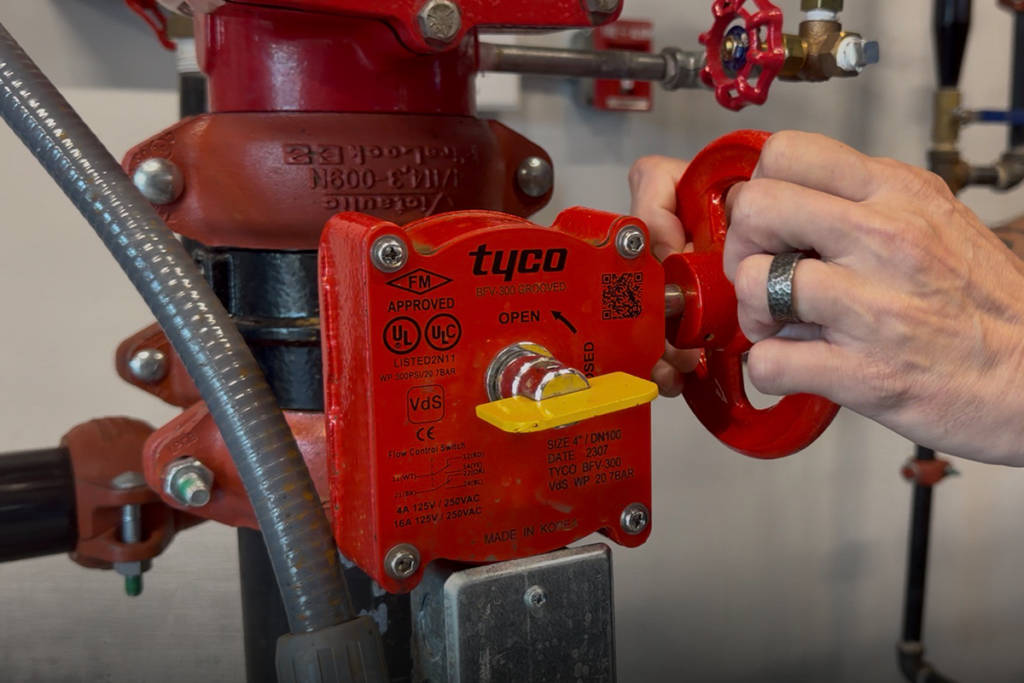
FIRE PUMP TESTING
By the Ironsmith Fire Engineering Team · Tennessee · Memphis and Nashville
A fire pump churn test runs the pump without flowing water into the system. It answers the only question that matters between fires: will this pump start on its own, hold pressure, and keep running? Diesel pumps are churn tested weekly. Most electric pumps are churn tested monthly, with higher-risk installations staying weekly. Every pump also gets a full annual flow test that proves it can actually deliver, not just spin.
Quick facts
- Governing standard: NFPA 25, which covers inspection, testing, and maintenance of water-based fire protection systems including fire pumps
- Diesel churn test: weekly, with enough run time to reach and hold operating temperature
- Electric churn test: monthly for most installations, weekly for defined higher-risk configurations
- Flow test: annually, measured at churn, at rated flow, and at overload
- Who is responsible: the building owner. The work can be delegated, the responsibility cannot
- The number that matters most: not pass or fail, but the trend line across years of flow tests
Your fire pump has one job: wake up and move water when the system demands it. It may sit silent for years between real fires, and that is exactly why NFPA 25 makes you prove it works on a schedule rather than on faith. Below is what each test actually involves, what failure looks like before it becomes failure, and why the building owner rather than the testing company is the one on the hook.
The churn test: the pump’s regular heartbeat check
A churn test runs the pump without flowing water to the system. It is the quickest honest answer to the only question that matters: will this pump start on its own?
Diesel fire pumps: weekly
Diesel drivers need real run time to come up to operating temperature. A two-minute bump tells you nothing about whether the engine will hold under load. During the run, the operator checks starting from the controller, oil pressure, cooling water flow, RPM, and suction and discharge pressures.
Electric fire pumps: monthly, with exceptions
Most standard electric pumps moved from weekly to monthly churn testing in more recent editions of NFPA 25. A defined set of higher-risk installations stayed weekly, including pumps with limited-service controllers, vertical turbine pumps, and pumps protecting buildings beyond what the local fire department can supply by pumper.
The exact exception list is edition-specific, and the edition your AHJ enforces is the one named in your state’s adopted code rather than the newest one in print. Ask your contractor to state on the report which frequency applies to your pump and why. If they cannot, that is worth knowing before an inspector asks the same question.
What the churn test catches early: batteries that will not hold a start, packing glands leaking past spec, casing relief valves stuck, pressure sensing lines gummed up, and a controller that starts only when a human is standing there pushing buttons.
The annual flow test: the full workout
Once a year the pump has to prove it can actually deliver, not just spin. The annual flow test measures performance at three points.
- Churn, or zero flow. Suction and discharge pressure with no water moving.
- Rated flow. The pump delivering its nameplate capacity.
- Overload. The pump pushed past rated flow, where it must still hold a defined share of its rated pressure.
The results get plotted against the pump’s original acceptance-test curve. NFPA 25 sets specific thresholds for when a degraded pump requires investigation and when it requires corrective action. Those numbers should appear on your test report alongside the measured values, not just a pass stamp.
That is the real point of the annual test. It does not just pass or fail the pump, it shows you the trend line. A pump that made full rated performance last year and slightly less this year is not broken. It is telling you what next year looks like.
What failure actually looks like
Fire pump failures almost never announce themselves. They accumulate.
- The engine that starts on the second try. This week. Next quarter it is the fourth try. The fire will not wait for the fourth try.
- Batteries that pass a voltage check but cannot crank under load. A common diesel failure mode, and invisible without a real weekly start.
- A wandering churn pressure. Often a failing casing relief valve, or a suction problem upstream of the pump entirely.
- The curve that keeps drifting down. Impeller wear, internal recirculation, or an obstruction in the suction. Every annual test that goes unplotted is a data point you paid for and threw away.
- The pump room itself. Heat failed over a cold snap, ventilation blocked, a closed suction valve someone meant to reopen. The routine visual checks exist because the room kills as many pumps as the machinery does.
An impaired fire pump is not a maintenance item. While it is down, every sprinkler and standpipe it feeds is running on city pressure alone, or on nothing. That is why deficiencies found during pump testing carry impairment procedures, notification duties, and paperwork your AHJ and your insurer both expect to see.
Who is responsible, and why one team should own the whole pump
Under NFPA 25 the building owner is responsible for making sure inspection, testing, and maintenance happen on schedule. You can delegate the work. You cannot delegate the responsibility.
Here is where it goes wrong in practice. One vendor tests the pump. Another services the controller. A third handles the sprinkler system the pump feeds. When the annual test shows a problem, every report points at someone else’s scope, and the pump sits deficient while the emails circulate.
A fire pump is not a standalone machine. It is the heart of a system: pump, driver, controller, suction supply, and the piping network it pressurizes. When it fails you do not need three vendors comparing notes. You need one team that owns the pump, the controller, and the water it moves. One call when something is wrong, one crew accountable for the fix, one set of records when the AHJ asks.
The schedule at a glance
| Task | Frequency | What it proves |
|---|---|---|
| Visual inspection of pump house, valves, leaks, heat | Weekly to monthly by item | The room is not killing the pump |
| Churn test, diesel | Weekly | It starts and holds temperature |
| Churn test, electric standard | Monthly | It starts on demand |
| Churn test, electric high-risk | Weekly | Same, with less margin for error |
| Flow test | Annually | It delivers rated flow at pressure |
| Maintenance per manufacturer | Ongoing | The trend line stays flat |
Frequencies reflect NFPA 25 as adopted in Tennessee. The enforceable edition is the one named in your state’s adopted code, and your AHJ has the final word.
Where Ironsmith Fire comes in
Ironsmith Fire runs fire pump programs across Memphis and Nashville: testing on the NFPA 25 schedule, deficiencies quoted and repaired by the same accountable team, and documentation that holds up when an inspector or an insurer asks. Pump testing sits inside our broader inspection, testing, and maintenance programs, so the pump and the system it feeds stay on one schedule.
Your fire pump has a test due. Do you know which one? We will review your pump, your records, and your current schedule, then tell you plainly what is current and what is overdue.
Frequently asked questions
How often does a diesel fire pump need to be tested?
Weekly. NFPA 25 requires a weekly no-flow churn test with enough run time for the engine to reach and hold operating temperature, plus a full annual flow test measured at churn, at rated flow, and at overload.
How often does an electric fire pump need to be tested?
Monthly for most electric pumps. Certain installations, such as pumps with limited-service controllers and vertical turbine pumps, remain on a weekly cadence. The exact exception list is edition-specific, so your contractor should state on the report which frequency applies to your pump. All electric pumps also get the annual flow test.
What is a fire pump churn test?
A churn test, also called a no-flow test, runs the pump without discharging water into the system. It verifies that the pump starts automatically, holds proper suction and discharge pressure, and for diesel drivers reaches and holds operating temperature.
What happens if my fire pump fails its annual flow test?
NFPA 25 defines thresholds at which a degraded pump requires investigation and at which it requires corrective action, measured against its original acceptance curve. The pump may be tagged deficient or impaired, which triggers notification and repair obligations. The fix, whether impeller, driver, controller, or suction, should be handled and re-tested by a qualified fire protection contractor.
Who is responsible for fire pump testing, the owner or the fire protection company?
The building owner. NFPA 25 puts inspection, testing, and maintenance responsibility on the owner. Contractors perform the work, but the owner answers for the schedule, the records, and the correction of deficiencies.