
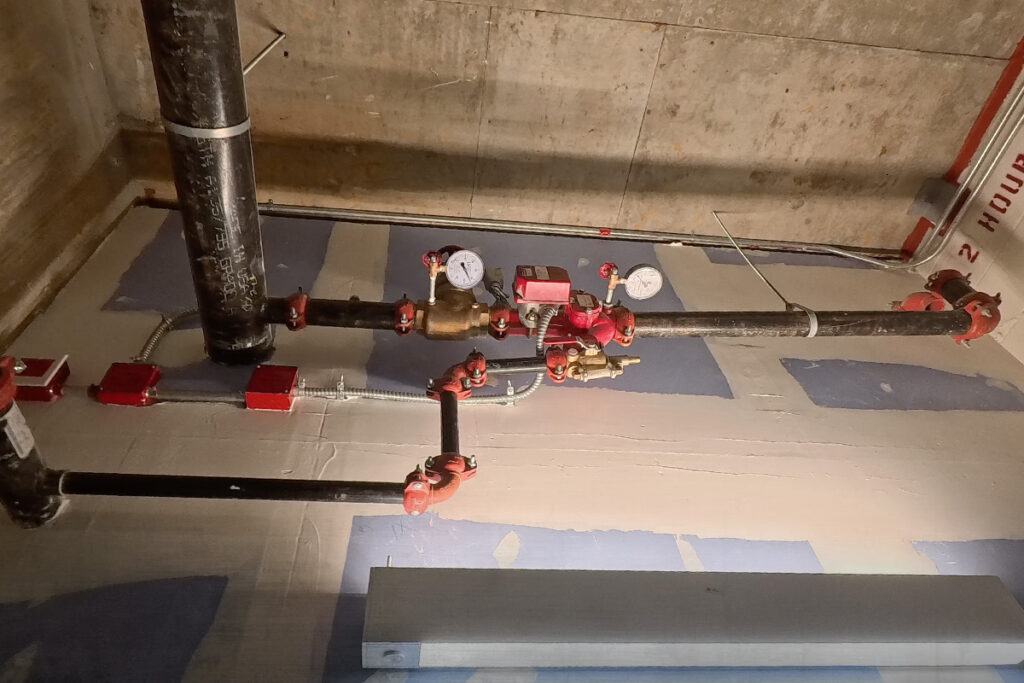
SYSTEM SELECTION
By the Ironsmith Fire Engineering Team · Memphis, Nashville, Jacksonville AR, Orlando, Houston
A wet vs dry sprinkler system comparison comes down to what sits in the pipe. A wet pipe system keeps water in the piping at all times, so water discharges the moment a sprinkler opens. A dry pipe system fills the piping with pressurized air or nitrogen and holds the water back at a valve in a heated room, so nothing in the cold space can freeze. Wet is the default for any space that stays at or above 40°F. Dry is for the spaces that don’t.
Quick facts
- The 40°F line decides it. NFPA 13 requires a dry pipe or preaction system wherever part of a system is subject to freezing and can’t be reliably kept at or above 40°F.
- Wet is the default. Water is already at the sprinkler. Fewer parts, faster response, lower cost to install and to own.
- Dry trades speed for freeze protection. Air has to leave the pipe before water arrives. NFPA 13 limits that delay, with a 60-second water delivery benchmark for larger systems.
- Dry systems are designed bigger. NFPA 13 increases the hydraulic design area by 30 percent for a dry pipe system to account for the delay. Same building, more water demand.
- Dry systems corrode faster. Trapped water plus the oxygen in compressed air attacks steel pipe from the inside. NFPA 13 permits nitrogen in place of air, and it’s a common fix.
- Dry systems need more testing. NFPA 25 calls for a dry pipe valve trip test every year and a full flow trip test every three years, with low point drains emptied before freezing weather.
- Most buildings use both. Wet in the heated building. Dry on the loading dock, in the parking garage or in the attic.
Wet vs dry sprinkler system: temperature makes the call, not preference
Owners ask which system is better. It’s the wrong question. Nobody picks a dry system because they like it.
A wet system is simpler, faster and cheaper to live with. You’d put one everywhere if you could. The only reason dry systems exist is that water freezes, frozen pipe splits, and a split pipe either floods the building when it thaws or fails when you need it. So the real question is narrower: can every foot of this pipe be kept warm, all winter, without anyone having to remember to do something?
If yes, go wet. If no, the cold portion needs another answer. This guide covers how each system works, what the dry option really costs you, and the cases where you don’t need a full dry system at all.
How a wet pipe system works
Water fills the piping from the riser to every sprinkler, under pressure, all the time. Each sprinkler is its own heat-activated valve. When fire heats one to its rated temperature, that sprinkler opens and water flows right away. Only the sprinklers over the fire open. The rest stay shut.
That’s the whole mechanism, and the simplicity is the point. There’s no air compressor, no dry valve, no trip sequence and nothing to reset beyond replacing the sprinklers that operated. Fewer components means there’s less to fail and less inspection, testing and maintenance work.
The limit is just as simple. Every part of the system has to stay at or above 40°F. One branch line run through an unheated vestibule, a soffit or an attic corner is enough to break a wet system in a hard freeze.
How a dry pipe system works
A dry system swaps the water in the piping for pressurized air or nitrogen. The water waits behind a dry pipe valve, and that valve lives in a heated room or enclosure.
The valve
The dry pipe valve is held shut by the gas pressure on the system side. When a sprinkler opens, the gas escapes, pressure drops, and the valve trips. Water then fills the piping and discharges from the open sprinkler. An air compressor or nitrogen generator keeps the system pressurized day to day, and a low air alarm tells you when it can’t keep up.
The delay
Here’s the tradeoff. In a wet system, water is at the sprinkler. In a dry system, the air has to get out first, then the water has to travel the length of the pipe. Fire keeps growing the whole time.
NFPA 13 limits that delay. Small dry systems, 500 gallons of pipe capacity or less, aren’t held to a delivery time. Systems up to 750 gallons can use a quick-opening device, usually an accelerator, to trip the valve faster. Larger systems have to prove they deliver water to the most remote test connection within a set time, 60 seconds for most occupancies and less for higher hazards. That’s why big unheated buildings often get split into several dry systems instead of one.
The design penalty
The standard also assumes the delay lets a fire open more sprinklers before water arrives. So NFPA 13 increases the hydraulic design area for a dry pipe system by 30 percent. The practical effect: bigger water demand, which can mean bigger pipe, and on a weak water supply it can mean a fire pump you wouldn’t otherwise need. Pipe also has to be pitched back to drains so water doesn’t sit in low spots after a test or a trip.
Wet vs dry, side by side
| Wet pipe system | Dry pipe system | |
|---|---|---|
| What’s in the pipe | Water, under pressure | Pressurized air or nitrogen |
| Where it fits | Any space reliably kept at or above 40°F | Spaces subject to freezing: loading docks, unheated warehouses, parking garages, attics, canopies |
| Response | Water discharges when a sprinkler opens | Delayed while gas exhausts and pipe fills |
| Design area | Base design area | Increased 30 percent under NFPA 13 |
| Extra equipment | None beyond the riser | Dry pipe valve, air compressor or nitrogen generator, low air alarm, low point drains, heated valve room |
| Corrosion risk | Lower | Higher: trapped water plus oxygen |
| Testing load | Lower | Higher: annual trip test, full flow trip test every three years, air leakage test, seasonal draining |
| Cost to install and own | Lower | Higher |
| After it operates | Replace sprinklers, restore | Replace sprinklers, drain the system, reset the valve, restore air |
What a dry system costs you after the install
The install price isn’t the whole cost. Dry systems ask more of an owner every year they’re in service.
Corrosion
A dry system is never truly dry. Trip tests put water in the pipe, and condensation adds more. Whatever doesn’t drain sits in the pipe next to a steady supply of oxygen from the compressor. That’s the recipe for internal corrosion: pinhole leaks first, then buildup that chokes flow. Nitrogen takes the oxygen out of the equation, and it’s worth pricing on any dry system you plan to keep for decades. If a dry system is already showing leaks, our corrosion protection service is the place to start.
Testing
NFPA 25 puts dry pipe valves on their own schedule. The valve gets a partial flow trip test every year and a full flow trip test every three years, which is the one that proves water really reaches the far end in time. The system also gets an air leakage test every three years. Add the gauges, the compressor, the low air alarm and any quick-opening device, and a dry system carries a heavier line on the NFPA 25 inspection schedule than a wet one.
Winter
Low point drains, also called drum drips, collect the water that pitch can’t carry back to the riser. They have to be emptied before freezing weather and checked through the season. Skip it and the water freezes in the drain, splits it, and trips the system. It’s a classic cold-weather failure. Our guide to purging a dry system before winter walks through it.
When you don’t need a full dry system
A cold corner doesn’t always justify a dry valve and a compressor. For small exposures, there’s often a lighter answer.
Dry sprinklers off a wet system
A listed dry sprinkler is a sealed length of pipe with the sprinkler at the cold end and the water held back at the warm end. The wet system stays in the heated space, and only the dry sprinkler reaches into the freezer, the canopy or the dock. It’s often the cleanest fix for a handful of heads.
Heat the space or the pipe
Insulating and heating a space so it holds 40°F lets it stay wet. Listed heat tracing on the pipe can do the same job, and it has to be supervised so a failure doesn’t go unnoticed.
Antifreeze
An antifreeze system is a wet system filled with a listed antifreeze solution. The rules on these have tightened in recent editions of the standards, so treat an old antifreeze loop as something to have evaluated, not something to copy.
Preaction
Preaction systems also keep water out of the pipe, but they need a detection system to release the valve. They’re built for spaces where an accidental discharge is the bigger fear, like data rooms. For freeze protection alone, dry pipe is the simpler tool.
How to tell which one your building needs
Walk the building with five questions.
- Heat. Does every space with sprinkler pipe hold 40°F on the coldest night of the year, including above ceilings and inside soffits?
- Reliability. Is that heat reliable, or does it depend on a unit heater someone has to turn on?
- Size. How big is the cold area? A few sprinklers point to dry sprinklers. A whole dock or garage points to a dry system.
- Water. Can the water supply carry the larger demand a dry system brings?
- Ownership. Who’s going to own the testing, the draining and the compressor for the next twenty years?
On new construction, those answers belong in design, before the pipe is drawn. Our fire sprinkler installation team works them out with the engineer of record and the authority having jurisdiction. On an existing building, a freeze-up or a corroded dry system is usually the moment to ask them again. Either way, you want the people who design it, install it and test it on the same side of the table. One call, one accountable team, and no finger-pointing between vendors.
Not sure what’s protecting your cold spaces? We’ll walk it with you.
Frequently asked questions
What is the difference between a wet and dry sprinkler system?
A wet sprinkler system keeps water in the piping at all times, so water discharges as soon as a sprinkler opens. A dry sprinkler system fills the piping with pressurized air or nitrogen and holds water back at a dry pipe valve in a heated area. When a sprinkler opens, the gas escapes, the valve trips and water fills the pipe. Wet systems are simpler and faster. Dry systems exist to protect spaces where water in the pipe would freeze.
When is a dry pipe sprinkler system required?
NFPA 13 requires a dry pipe or preaction system where any portion of the system is subject to freezing and can’t be reliably maintained at or above 40°F. Common examples are loading docks, unheated warehouses, parking garages, attics and exterior canopies. For small cold areas, listed dry sprinklers fed from a wet system can be an accepted alternative. Your designer and the authority having jurisdiction make the final call.
Are dry sprinkler systems slower than wet systems?
Yes. Water can’t discharge until the gas in the pipe escapes and water travels to the open sprinkler. NFPA 13 limits the delay. Larger dry systems have to deliver water to the most remote test connection within a set time, 60 seconds for most occupancies, and the standard increases the hydraulic design area by 30 percent to account for the fire growing during that delay.
Do dry sprinkler systems need more maintenance?
Yes. Under NFPA 25, a dry pipe valve gets a partial flow trip test every year and a full flow trip test every three years, and the system gets an air leakage test every three years. Low point drains have to be emptied before freezing weather. The air compressor or nitrogen generator, gauges, low air alarm and any quick-opening device add inspection items a wet system doesn’t have. Dry systems are also more prone to internal corrosion.
Can one building have both wet and dry sprinkler systems?
Yes, and most buildings with cold spaces do. A wet system protects the heated building, and a separate dry system, or dry sprinklers, protects the dock, garage, attic or canopy. Each dry system has its own valve and its own testing schedule, so keep them clearly labeled and make sure your inspection reports cover every system in the building.