
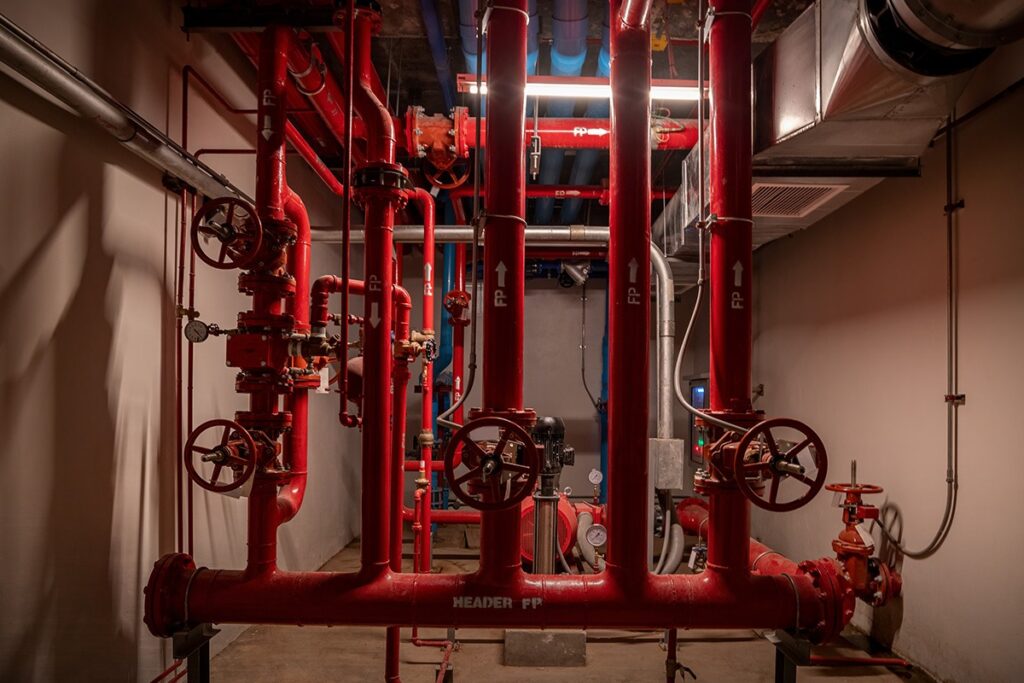
FIRE PUMP RELIABILITY
By the Ironsmith Fire Engineering Team · Memphis, Nashville
A fire pump failure is any condition that keeps a fire pump from starting on its own, building rated pressure and flow, or running until the fire is out. Most failures don’t happen in one moment. They build up between tests: a controller left in manual, a weak battery, a valve that never got reopened, a clogged cooling line. Churn tests and the annual flow test exist to catch them before a fire does.
Quick facts
- The pump has one job. Start on its own and move water when system pressure drops.
- Simple oversights cause a lot of failures. Insurers keep pointing to controllers left in manual and valves left closed.
- Diesel pumps add risk. Batteries, fuel and engine cooling all have to be ready on a pump that may sit idle for years.
- A diesel fire pump won’t protect itself. It has no high temperature shutdown. In a fire, it runs until something breaks.
- Cost here means consequences, not dollars. Impairment, fire watch, deficiencies, a call to your insurer, and in the worst case no water.
- Tests catch most of these first. Weekly checks, churn tests and the annual flow test.
Fire pump failure: what it looks like and what it costs you
A fire pump can sit for years without fighting a fire. That’s the problem. It can fail quietly, and nobody notices until the sprinklers open and the pressure isn’t there.
Below are seven common causes of fire pump failure, drawn from insurer guidance, engineering write-ups and inspector training material. For each one: what goes wrong, how it shows up, and what it costs you.
We don’t mean repair bills. The real cost lands on the system the pump feeds. The pump gets tagged impaired. Sprinklers and standpipes run on city pressure alone, or not at all. The authority having jurisdiction (AHJ) and your insurer expect to hear about it, and you may owe a fire watch. If a fire starts first, the system may not deliver the water it was designed around.
For the testing schedule itself, see our guide to how often a fire pump should be tested. This post is the troubleshooting side.
1. The pump doesn’t start on its own
Nothing else counts if the pump never turns. It should start automatically when its controller senses a pressure drop. Several things break that chain.
The controller gets left in manual or off, often after a nuisance start or service work. Swiss Re’s risk engineers describe a contractor who switched a fire pump to manual during work and never switched it back. A fire started, the sprinklers opened, and the pump didn’t.
On electric pumps, power is the next weak link. A tripped disconnect, a failed transfer switch or a dark power light on the controller means the motor can’t run. Then there’s the sensing line, the small tube that lets the controller read system pressure. Clog it or valve it off and the controller never sees the drop.
Settings can do it too. Engineers who survey pump rooms find pressure switches set so the jockey pump does all the work and the main pump never starts.
What it costs you. A pump that won’t start automatically is impaired. Every sprinkler and standpipe it feeds is short on pressure, and the impairment process kicks in: tag it, notify the AHJ and your insurer, set up a fire watch.
2. Diesel batteries and fuel go bad
Diesel pumps don’t need building power. That’s why sites choose them. But they bring their own risks.
Batteries
The engine cranks off batteries. Corrosion, sulfation and age cut cranking power. FM’s Boiler Re group lists power interruptions to diesel engine batteries among the causes of fire pump failure, and inspector training material puts battery trouble on its short list of diesel faults.
Fuel
Stored diesel degrades. John Denhardt, PE, writing for AFSA, notes it breaks down unless steps are taken to slow it, and that many owners skip the fuel monitoring and testing NFPA 25 includes. Microbes and clogged filters follow. Inspector training also calls for keeping the tank at least two thirds full.
What it costs you. A diesel that won’t crank, or starts and then starves, is the same as no pump. If you chose diesel to ride through a power outage, a neglected one won’t.
3. Valves left closed or partly closed
A fire pump sits in a train of valves: suction, discharge, test header and system control valves. One in the wrong position can stop water.
Insurer guidance built on NFPA research calls closed valves one of the leading causes of sprinkler system failure. Swiss Re, citing NFPA data, says a system not in service accounts for nearly two thirds of the events where sprinklers failed to operate. Valves get shut for repairs, construction or a frozen pipe, and they don’t always get reopened.
A partly closed valve is harder to spot. The pump starts but can’t deliver, and that may not show until the annual flow test. Insurer checklists for electric fire pumps start with confirming, every week, that valves between the water source and the system are open.
What it costs you. A closed valve turns a healthy pump into dead weight. In a fire, that can be the difference between a controlled event and a total loss. In a normal week, it’s a deficiency on your report and a correction to document.
4. Suction trouble and cavitation
A fire pump can only push what it can pull. Inspector training lists a closed suction valve, a clogged strainer and debris in the impeller among the reasons a pump runs but won’t make pressure. On tank supplies, pump room surveys turn up dry or disconnected priming lines and tanks holding less water than they should.
When the pump can’t get enough water, it can cavitate. Low pressure at the impeller forms vapor bubbles that collapse with force. It sounds like gravel in the pump, pressure jumps around, and over time it eats the impeller.
What it costs you. A starved pump fails its flow test, or passes at churn and falls short under real demand. The fix may be the water supply, not the pump.
5. Overheating
Fire pumps are built to run hard, not hot.
Diesel cooling water
Many diesel engines are cooled by water taken off the pump discharge and run through a heat exchanger. Steven Lindholm, PE, a forensic engineer, calls that cooling method a major root cause of damage to standby diesel fire pumps. He describes engines run with the cooling line valved off that ended up with distorted cylinder heads and burnt pistons. Warren Forensics adds clogged strainers and solenoid valves that fail closed. And a diesel fire pump engine has no high temperature shutdown. It’ll keep running in a fire even if that wrecks the engine.
Relief valves on electric pumps
At churn, with no water flowing out, water in the pump casing heats up. A small relief valve bleeds off a little to keep it cool. Those valves aren’t known for reliability, and if one sticks shut, the casing can overheat during the test run.
What it costs you. An overheated diesel can seize during the fire you bought it for. An overheated casing damages seals and internal parts. Either way, the pump goes out of service for repairs you didn’t plan.
6. Packing and seal problems
Many fire pumps seal the shaft with packing, rings squeezed around it by a gland. Packing is supposed to drip. Manufacturer guidance and inspector training both put the rate at roughly a drop a second. That water lubricates and cools it.
Too much leakage means worn or loose packing. No drip at all means it’s too tight: it runs dry, burns and damages the shaft sleeve. A smoking gland is the tell. Mechanical seals fail differently, usually from running dry, poor setup or vibration.
What it costs you. Left alone, a simple adjustment turns into a shaft and sleeve repair. That’s a pump out of service and an impairment while it’s apart.
7. Misalignment and vibration
The pump and driver have to line up.
FM’s Boiler Re group names misalignment at installation, poor lubrication and overloading as causes of coupling failure. It notes elastomeric couplings fail at a higher rate and recommends steel types instead. Alignment specialists note that NFPA 20 and NFPA 25 call for alignment to the manufacturer’s recommendations with a yearly check. Inspector training lists misalignment, worn bearings and a bent shaft as the usual causes of vibration.
What it costs you. Misalignment wears out bearings, seals and couplings. A failed coupling means the driver spins and the pump doesn’t.
The cost of each failure, at a glance
| Failure | How it usually shows up | What it costs you |
|---|---|---|
| Doesn’t start on its own | Controller in manual or off, no power light, no start on pressure drop | Impairment, fire watch, notice to AHJ and insurer |
| Diesel batteries and fuel | Slow or failed crank, charger alarms, dirty filters | No pump in a power outage |
| Closed or partly closed valves | Weekly inspection finding, weak flow test | No water to the system, deficiency on report |
| Suction trouble and cavitation | Noise, jumping pressure, low flow results | Failed flow test, possible water supply fix |
| Overheating | Hot casing at churn, no flow from cooling line | Engine or pump damage, out of service |
| Packing and seals | Steady stream or no drip, smoking gland | Shaft and sleeve damage |
| Misalignment and vibration | Noise, vibration, worn coupling | Bearing, seal and coupling failure |
Fire pump troubleshooting starts with the tests
Almost every failure above shows up on a test before a fire.
Run the tests and read them
The churn test confirms the pump starts automatically, the relief valve flows, the packing drips and, on a diesel, the engine and cooling loop hold up. The annual flow test shows whether the pump still delivers what it did when new. Compare each year to the last. Our fire pump testing team runs both on the NFPA 25 schedule.
Watch the jockey pump
The jockey pump makes up small pressure losses from leaks and temperature swings. That means it can hide a growing leak. If it starts more often than it used to, find out why.
Close out deficiencies
An open deficiency is a bet the pump won’t be needed. If an inspection turned up problems, here’s what to do after a failed fire inspection.
Keep it under one roof
Fire pumps fail at the seams between vendors. You want one call, one accountable team for the pump, the controller and the system it feeds.
When did your fire pump last start on its own? Let’s find out.
Frequently asked questions
What is the most common cause of fire pump failure?
There’s no single published ranking, but the same causes come up again and again in insurer and engineering guidance: a controller left in manual or off, closed valves, weak diesel batteries, suction problems and overheating. Many are human error rather than worn parts, which is why weekly inspections and regular churn tests matter.
Why won’t my fire pump start automatically?
The usual suspects are a controller in manual or off, lost power to an electric pump, weak batteries on a diesel, or a clogged or closed sensing line that keeps the controller from seeing the pressure drop. Pressure settings can also be the cause if the jockey pump handles every drop and the main pump never reaches its start point. A qualified technician should trace it before the pump goes back in service.
What happens when a fire pump is out of service?
The pump is impaired, and so is the protection it supports. Under NFPA 25 impairment procedures, the system gets tagged, the authority having jurisdiction and your insurer are notified, and a fire watch is usually put in place until the pump is repaired and tested. Sprinklers and standpipes may be running on city pressure alone in the meantime.
How much should a fire pump packing gland drip?
Packing is supposed to drip. Pump manufacturer guidance and inspector training both put the normal rate at roughly one drop per second. A steady stream means the packing is worn or loose. No drip at all means it’s too tight and can burn and damage the shaft sleeve. Adjustments should be small and made by a trained technician.
Can a fire pump overheat?
Yes. A diesel engine can overheat if its cooling water line is closed or clogged, and a diesel fire pump engine has no high temperature shutdown, so it keeps running until something breaks. Electric pumps can overheat at churn if the small relief valve that bleeds off water sticks shut. Checking cooling water flow and relief valve discharge during every churn test catches both.