
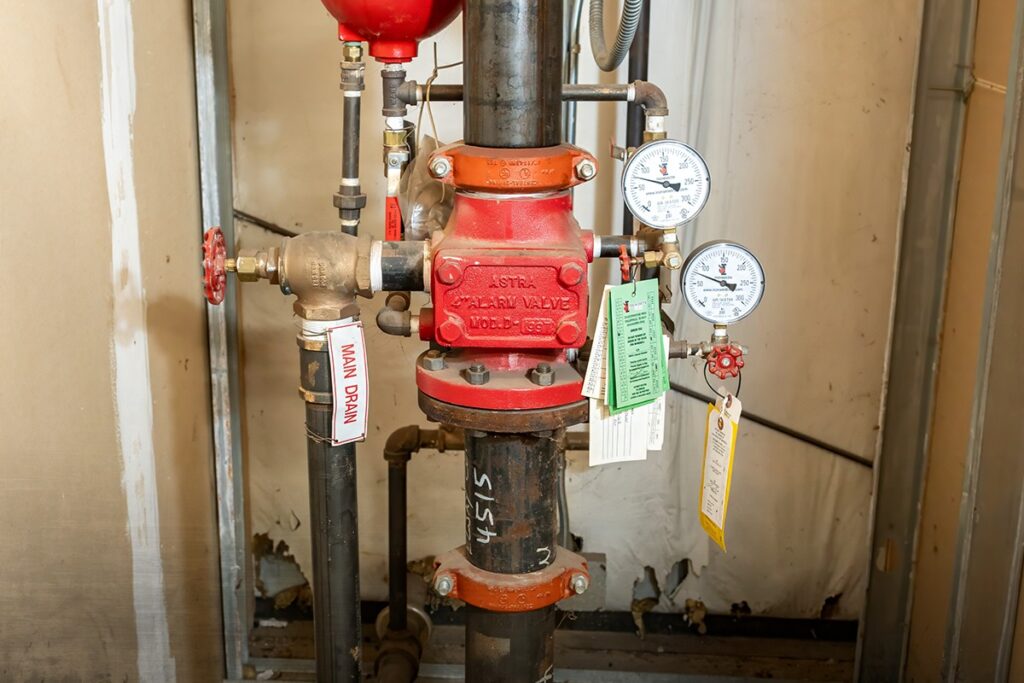
DRY SYSTEM WINTER RISK
By the Ironsmith Fire Engineering Team · Memphis, Nashville
Dry sprinkler system low point drains are small valved drains installed wherever dry pipe dips below the level of the main drain and traps water. Condensation and leftover test water collect in those low spots. If nobody drains them, that water freezes, splits pipe or fittings, and can trip the dry valve. NFPA 25 expects them drained before freezing weather and as often as needed through the season.
Quick facts
- A dry system is never fully dry. Trip tests leave water behind, and compressed air brings moisture in with every cycle.
- Water runs downhill and stays there. Any spot where the pipe dips and climbs back up becomes a collection point.
- Low point drains are the fix. Small trapped sections get a simple valve and plug. Larger ones get a drum drip, a two valve drain with a short pipe reservoir between the valves.
- Sequence matters. Opening both drum drip valves at once vents system air and can trip the dry valve. Draining is a trained task.
- NFPA 25 sets the rhythm. Drain low points after every system operation, before freezing weather, and as needed all winter.
- Nitrogen helps. It cuts the moisture and oxygen that compressed air feeds into the pipe. It doesn’t replace draining.
Why dry sprinkler system low point drains fail in winter
A dry system exists for one reason: to keep water out of pipe that runs through cold space. The water waits behind a dry pipe valve in a heated room, and the pipe holds air or nitrogen instead. If you want the basics of how that works, start with our guide to wet vs dry sprinkler systems.
Here’s the catch. That pipe still collects water. It settles in the lowest spots, sits quietly through the fall, and freezes on the first hard night. A hard freeze can show up between mild days. The drain nobody emptied in October becomes the failure in January.
This post covers where low points hide, why they fail, how they’re drained, and what NFPA 25 expects.
Where the water comes from
Three sources feed water into a dry system.
Trip test water
NFPA 25 calls for regular trip testing of dry pipe valves, and every test sends water into the piping. Pitch only carries it so far. Whatever can’t run back to the main drain stays in the low spots.
Condensation from compressed air
Fire Engineering’s Gregory Havel points out that compressor air brings in both oxygen and moisture. When that air hits cold pipe, the moisture condenses and collects. Every time the compressor tops off a small leak, it adds a little more water.
Past operations
After an activation or an accidental trip, the whole system fills with water. Draining gets most of it out, not all of it.
Where low points hide
A low point is any section of dry pipe that can’t drain back to the main drain by gravity. Telgian describes drum drips as sitting at the lower portions of a system or wherever pipe elevation changes. NFPA 13 requires an auxiliary drain wherever a change in direction keeps a section from draining through the main drain, as QRFS explains.
In a real building, that means the pipe had to get around something:
- Beams and joists. A main that drops under a beam and climbs back up leaves a trap on the low side.
- Ductwork. Pipe routed under a duct run forms the same dip.
- Soffits and bulkheads. Short drops into a soffit trap water at the bottom.
- Dock door headers. Pipe that drops to clear an overhead door and rises again is a classic trap at the coldest wall in the building.
- Canopy drops. Branch lines feeding an exterior canopy often step down, and that step holds water.
- Pipe sag. Hangers loosen, pipe gets bumped, and a line that once pitched to drain now sags. That’s a low point nobody planned for, and it has no drain. The unplanned ones are the dangerous ones.
Signs a low point is in trouble
- Frost or ice on the outside of a pipe or a drain valve
- Rust staining or drips under one spot on the line
- A compressor that runs more than it used to
- A dry valve that trips with no fire and no obvious cause
- Pinhole leaks that keep showing up in the same area
Any one of these is worth a call.
Why low points fail
Freezing and splitting
Water expands as it freezes. In a drum drip, a fitting or a sagging branch line, that can split pipe or crack a fitting. When the ice thaws, the leak starts. Warren Forensics describes what comes next: once leakage outruns the compressor, the dry valve trips and water fills pipe sitting in a freezing space.
Ice plugs
Ice doesn’t always split pipe. Sometimes it just blocks it. Risk Logic warns that ice plugs can slow or completely block water flow to sprinklers during a fire. You won’t see a plug from the floor.
Corrosion at the low spots
Water that’s sitting in a low point next to a steady supply of oxygen corrodes the pipe from the inside. Havel notes that corrosion deposits and pits gather at low points, leading to leaks and restricted flow. If you’re seeing leaks clustered in one area, our corrosion protection team can find out why.
Where nitrogen fits
Nitrogen generators replace compressor air with dry nitrogen, cutting the oxygen and moisture going into the pipe. NFPA 13 permits nitrogen, and Reliable’s technical literature warns that compressed air should not be treated as dry air. But nitrogen doesn’t remove water that’s already in the pipe. Low points still need draining.
How low points are drained
Auxiliary drains
Small trapped sections get a simple auxiliary drain: a valve with a plug or cap. Open it, catch the water, close it, replace the plug.
Drum drips: the two valve sequence
Larger trapped sections get a drum drip. NFSA and Telgian both describe the setup: two valves with a short length of larger pipe between them. The upper valve stays open, so water drips down into that reservoir. The lower valve stays closed.
Draining it works like an airlock. Close the upper valve to isolate the reservoir from the system. Open the lower valve and let the water out. Close the lower valve. Reopen the upper valve. Repeat until no water comes out, then replace the plug or cap.
Here’s why it’s a trained task. Open both valves at once and you vent system air straight to atmosphere. QRFS and Telgian both warn this can trip the dry valve. Skip a step or forget to reopen the upper valve and the drip can’t collect water. A trip in January means water in pipe that’s sitting in the cold.
We’d rather walk your team through it than have someone learn it during a freeze. Our guide on purging a dry system before winter covers the prep side.
What NFPA 25 expects
NFPA 25 covers auxiliary drains in its chapter on valves and valve components. NFSA and QRFS summaries of that chapter agree on three triggers for draining low points on dry systems:
- After every operation of the system
- Before the onset of freezing weather
- As needed through the cold season
The standard’s guidance is practical: drain daily as cold weather approaches and after any operation, then cut back as the discharge drops off. Telgian puts it bluntly: drain them routinely through fall and winter even when you don’t find water.
NFPA 25 also expects the wet side of the dry valve to stay at 40°F or above, with the valve room checked on a set schedule during cold weather.
Make low points part of the plan
Low points aren’t a one time chore. They belong on a list: where every drain is, how much water each gave up last time, and who’s draining it this week. Keep it with your inspection reports. Got antifreeze loops too? Put them on the same list, since they need their own annual test. Here’s what NFPA now requires for antifreeze systems.
Our fire sprinkler maintenance team inspects, drains, finds the hidden traps and fixes what’s causing them. One call, one accountable team, from the first drain in October to the last freeze in spring.
Not sure where your low points are? We’ll find them before the first freeze does.
Frequently asked questions
What is a low point drain on a dry sprinkler system?
A low point drain, also called an auxiliary drain, is a small valved drain installed where dry system piping dips and can’t drain back to the main drain by gravity. Water from trip tests and condensation collects there. Draining it keeps that water from freezing, splitting pipe or tripping the dry valve.
What is a drum drip?
A drum drip is a two valve low point drain used on larger trapped sections of dry pipe. A short length of larger pipe sits between an upper valve and a lower valve. The upper valve stays open so water collects in the pipe between them. To drain it, the upper valve is closed first, then the lower valve is opened. Opening both at once can vent system air and trip the dry valve.
How often should dry system low point drains be drained?
NFPA 25 calls for draining low points after every system operation, before freezing weather, and as needed through the cold season. Industry guidance based on the standard recommends draining daily as cold weather approaches, then reducing frequency as the amount of water drops. Drains that keep producing water should stay on a frequent schedule.
Why does my dry sprinkler system keep tripping in winter?
Common causes include water freezing at a low point and splitting pipe or fittings, air leaks the compressor can’t keep up with, and a drum drip opened in the wrong sequence. Repeated trips aren’t normal. Have a qualified fire protection contractor inspect the system, find the low points and correct the cause.
Does nitrogen stop dry sprinkler pipes from freezing?
Not by itself. Nitrogen replaces compressor air with dry gas, which cuts the moisture and oxygen entering the pipe and slows corrosion. It doesn’t remove water that’s already in the system from trip tests or past operations. Low point drains still have to be drained before freezing weather and through the winter.