
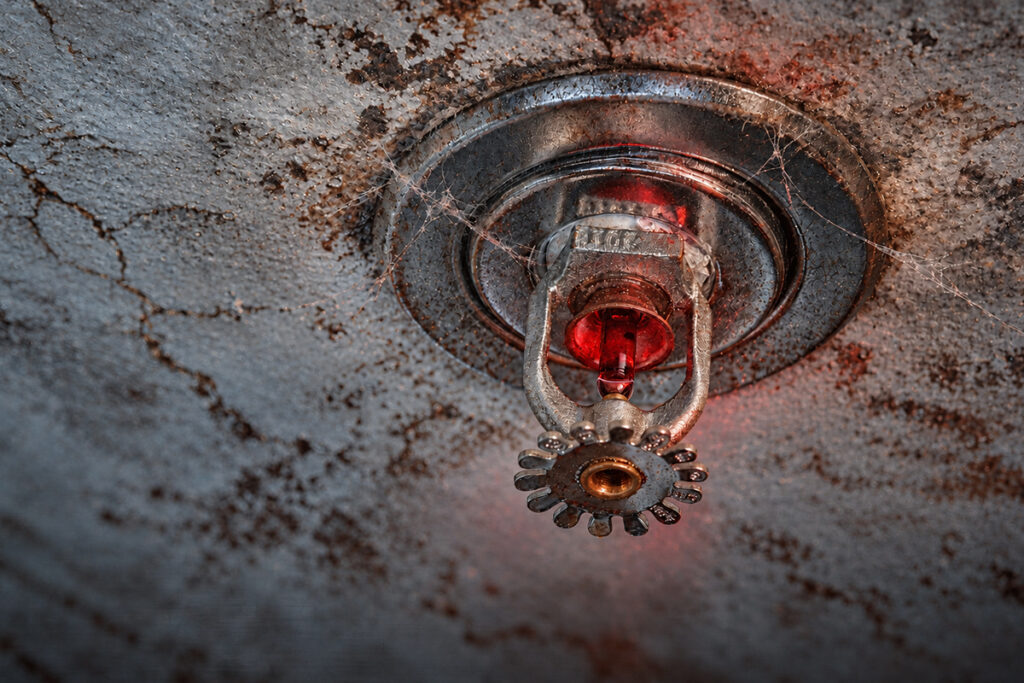
WHAT’S INSIDE YOUR PIPE
By the Ironsmith Fire Engineering Team · Memphis, Nashville, Jacksonville AR, Orlando, Houston
A fire sprinkler obstruction is anything inside the piping, or on the sprinkler itself, that slows or blocks water on its way to a fire. Corrosion nodules, pipe scale, construction debris, ice and even shellfish all qualify. NFPA 25 requires an internal assessment of sprinkler piping every five years, and a deeper obstruction investigation when warning signs show up.
Quick facts
- Corrosion happens in every system. FM Global’s research says so plainly. Its byproducts and mineral deposits can restrict flow and plug sprinklers.
- Dry systems take the worst of it. Dry-pipe systems were involved in 59% of the obstructed-pipe fire losses reported to FM Global from 1982 to 2001.
- Scale is the top cause in dry systems. It breaks loose when the system trips and rides the water to the sprinklers.
- Crews leave things behind. Lumber, gloves, buckets and the metal discs cut out of drilled pipe have all turned up inside sprinkler mains.
- Some of it is alive. Zebra mussels and Asiatic clams can move into systems fed by river or lake water.
- Every five years, someone looks inside. NFPA 25 calls it an internal assessment. Warning signs trigger a full obstruction investigation.
Why fire sprinkler obstruction is the scariest thing in your building
It’s Halloween, so let’s talk about what’s hiding in the dark.
Most of your sprinkler system lives above the ceiling, full of water that hasn’t moved in years. Nobody sees it. Nobody thinks about it. And it has to work the one time it’s needed.
A fire sprinkler obstruction doesn’t announce itself. The gauges read fine. The tag is current. Then a head opens, and what reaches it is a trickle, a slug of rust or nothing at all.
Everything below has been documented inside real systems by insurers, investigators and the sprinkler industry’s own research. No made-up ghost stories.
1. The slime: microbiologically influenced corrosion
MIC starts as a biofilm, a slime that grows on the wet inside of the pipe. It shows up in wet and dry systems alike. The bacteria in that film produce acids and other byproducts that attack the steel from the inside out.
What it looks like belongs in a haunted house. Lumps called tubercles, colored orange, red, brown, black or white. Under each lump, a cup-shaped pit. Copper pipe gets green-blue deposits and blue slime.
The warning signs: black water from the drain, a rotten egg smell and pinhole leaks, often at threads or weld seams.
Keep it in perspective, though. MIC gets the headlines, but FM Global’s research puts it at roughly 10 to 20 percent of corrosion damage, based on the estimates it cites. Most corrosion is plain oxygen at work.
2. The rust monsters: oxygen corrosion
Water plus trapped air equals corrosion. In a wet system, air pockets feed oxygen that pits the pipe under rust nodules until a pinhole opens.
Dry and preaction systems have it worse. The compressor keeps pushing oxygen-rich air into pipe that still holds water from testing or condensation. FM Global’s research found new dry and preaction systems can start leaking within about two to three years.
The fix is chemistry, not luck. FM Global recommends nitrogen as the supervisory gas in dry systems and air vents in wet systems. Our corrosion protection services page covers the options.
3. The bones: pipe scale and mineral deposits
Scale is the leading cause of obstruction in dry systems. Flakes of rust and mineral build up on the pipe walls. When the system trips, rushing water tears them loose and carries them straight to the sprinkler orifices.
Hard water adds its own layer. Calcium carbonate deposits can plug orifices all by themselves.
4. The leftovers: what the crew forgot
This one makes inspectors laugh, then wince. Construction and repair crews leave things in pipe. Documented finds include wood, brushes, buckets, gravel, sand, gloves and the cutout discs left behind when a hole is drilled into a main.
NFSA reported that a division chief with the Anne Arundel County, Maryland, Fire Marshal’s Office found a 2×4 during a flush. Intact work gloves and trash have come out of pipe too.
None of it is a ghost. It’s a skipped flush.
5. The creatures: mussels and clams
Systems fed by rivers, lakes or ponds can pull in a lot more than water. Mud, sand, stones, sticks and wood chips come through a poorly screened intake. So do zebra mussels and Asiatic clams. Once inside, they settle in and grow. NFSA notes the clams can grow past 2 inches across.
Where shellfish are a known problem, the obstruction investigation repeats every five years, because the problem keeps coming back.
6. The ice plug: frozen condensate in cold storage
Dry and preaction piping that runs into freezers carries air that holds moisture. When that air’s dew point sits above the pipe temperature, condensation freezes inside. Over time it builds an ice plug that can choke off, or completely block, water to the freezer. That’s why NFPA 25 calls for ice checks on piping in spaces kept below freezing.
7. The stuff on the outside
Not every fire sprinkler obstruction lives inside the pipe. On the head itself, watch for:
- Paint. Paint that didn’t come from the manufacturer is a deficiency, and it can’t be cleaned off. A painted head that can’t do its job gets replaced.
- Corrosion and loading. Dust, grease, cobwebs and buildup that affect how the head works mean replacement.
- Storage creep. Keep at least 18 inches between the top of storage and the sprinkler deflectors, and more for some special sprinklers like ESFR. Ask your inspector what applies to your building.
How the five-year look inside works
NFPA 25 requires an internal assessment of sprinkler piping every five years. The inspector opens the system and looks for corrosion and foreign material. Our guide to the 5-year internal pipe inspection walks through it step by step.
If the assessment or anything else turns up warning signs, the next step is a full obstruction investigation. Triggers include:
- Debris coming out during water tests
- Foreign material in fire pumps, dry pipe valves or check valves
- A plugged inspector’s test connection, or plugged sprinklers
- Pinhole leaks
- A dry pipe valve that trips on its own, again and again
- A broken public main nearby, or a main that wasn’t flushed after repairs
- A system that’s been shut down for more than a year
- Raw water pumped in through the fire department connection
Don’t wait for the jump scare
Pinholes, black water and that rotten egg smell are your system telling you something. So is a dry valve that keeps tripping. Treat the cause, not just the leak, and keep the five-year assessment on your inspection, testing and maintenance calendar. Our five-year internal inspection crews open the pipe, document what’s inside and tell you what it means.
What’s living in your pipe? Let’s find out before a fire does.
Frequently asked questions
What is a fire sprinkler obstruction?
A fire sprinkler obstruction is anything that slows or blocks water from reaching a fire. Inside the pipe, that includes corrosion nodules, scale, construction debris, ice and shellfish. On the sprinkler itself, it includes paint, corrosion, buildup and storage stacked too close to the head.
What causes obstructions in fire sprinkler pipe?
The most common causes are oxygen corrosion, microbiologically influenced corrosion, pipe scale and mineral deposits. Debris left during construction or repairs, raw water drawn from rivers or ponds, and ice in dry systems running through freezers also cause obstructions.
How often does NFPA 25 require an internal pipe inspection?
NFPA 25 requires an internal assessment of sprinkler piping every five years. If that assessment or another test turns up warning signs, such as debris, plugged sprinklers or pinhole leaks, a full obstruction investigation follows.
What are the signs of MIC in a sprinkler system?
Common signs of microbiologically influenced corrosion include black water from drains, a rotten egg smell, pinhole leaks at threads or welds, and colored lumps called tubercles inside the pipe. A pipe sample and lab testing confirm it.
Can a painted sprinkler head be cleaned?
No. Paint and corrosion can’t be cleaned off a sprinkler head. A head with paint that wasn’t applied by the manufacturer is a deficiency, and if it affects how the head works, the head gets replaced.