IMPAIRMENT RESPONSE
By the Ironsmith Fire Engineering Team · Memphis, Nashville, Jacksonville AR, Orlando, Houston
Fire watch requirements apply when a sprinkler system, fire alarm or other required fire protection system is out of service. A fire watch is a trained person whose only job is to patrol the affected area, look for fire and call the fire department if they find one. The fire code official decides when a fire watch is required. NFPA 25, the International Fire Code and NFPA 1 set the triggers. Local fire marshals set the details.
Quick facts
- Call first. The International Fire Code (IFC) requires immediate notice to the fire department and the fire code official when a required system goes out of service.
- The IFC has no grace period. The fire official can require a fire watch or evacuation as soon as the system is down.
- NFPA 25 draws a 10 hour line. A sprinkler system impaired more than 10 hours in a 24 hour period triggers extra steps, such as a fire watch. The hours add up across the day.
- Florida uses 4 hours. NFPA 1, the base of the Florida Fire Prevention Code, calls for a fire watch or evacuation when a fire protection system is out more than 4 hours in 24.
- One job only. The person on fire watch does nothing else while on duty.
- Log every round. Time, name and what was checked. Keep it for the fire marshal.
- Local rules set the pace. Required rounds run from every 15 minutes to every hour, depending on the jurisdiction and the occupancy.
Fire watch requirements start the hour your system goes down
A frozen pipe splits at 2 a.m. A fire pump won’t start. A forklift clips a branch line. A contractor closes a valve for a remodel. However it happens, your building just lost its protection, and the clock is running.
NFPA 25 calls this an impairment. Its chapter on impairments lays out what the owner has to do, and the IFC adds the fire watch. Here’s the order we’d follow.
Step 1: Put one person in charge
NFPA 25 calls for an impairment coordinator. That’s the person who runs the response, makes the calls and decides when the system is back. If nobody’s been named, the owner holds the job by default.
Name this person now, before anything breaks. Give them the keys, the riser room location and the phone list.
Step 2: Make the calls
Under the IFC, the fire department and the fire code official get notified immediately. NFPA 25’s list is longer. Call these:
- The fire department and the fire marshal’s office
- Your alarm monitoring company, so they know why signals are coming in
- Your insurance carrier
- The building owner, if that isn’t you
- Occupants and supervisors in the affected areas
Insurers take this seriously. FM Global runs a Red Tag permit program for its clients, and Chubb publishes an online impairment notice form. Check your policy. Some carriers have their own deadlines.
Step 3: Tag the system
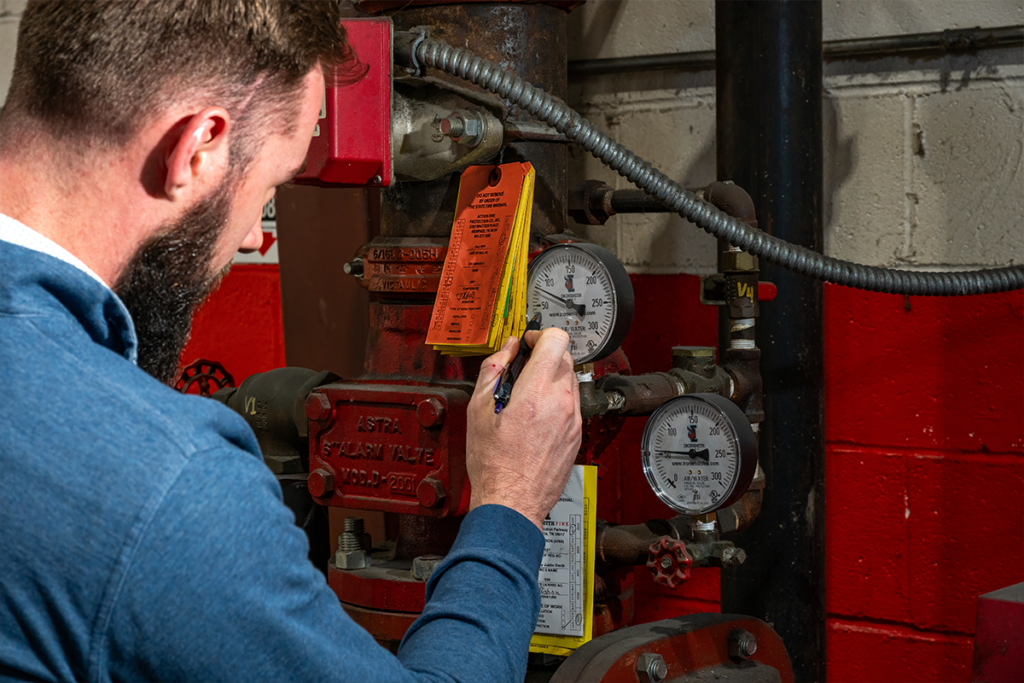
NFPA 25 and the IFC both call for a tag that marks the system as out of service. It goes at the fire department connection and the control valve. The IFC adds the fire alarm control unit and annunciator when the alarm is involved. The tag tells arriving firefighters they can’t count on that system.
Step 4: Start the fire watch
Here’s the part people get wrong. A fire watch isn’t a guard at the front desk who walks around now and then.
Who can stand fire watch
The sources we checked allow building staff, security or a contractor, as long as the fire official approves. The rule that matters is focus. The person on watch doesn’t do anything but fire watch. Some jurisdictions, such as Charlotte, North Carolina, specifically bar security officers who still have other duties.
Every fire watch needs:
- A way to call 911. A charged phone or radio, on them at all times.
- Extinguisher training, and knowledge of where the extinguishers are.
- Access to every area on the route, including locked rooms.
What to patrol
Every affected area, not just the hallways. That includes storage rooms, closets, attics and other concealed spaces where a fire can grow unseen.
How often to patrol
The fire official sets the interval, and it isn’t the same everywhere. La Vergne, Tennessee calls for rounds every 15 minutes in sleeping, institutional and assembly occupancies and every 30 minutes elsewhere. Osceola County, Florida calls for hourly rounds. Ask your fire marshal. Don’t guess.
What to log
Each round gets a line in the log: time, name, areas checked and anything found. Some jurisdictions want the log turned in daily. All of them expect it on hand when the fire marshal stops by.
Step 5: Fix it, test it, restore it
The fire watch doesn’t end when the repair crew leaves. It ends when the system works again. NFPA 25 calls for testing the system after repairs, notifying everyone you called in Step 2 and removing the tags. Some fire departments inspect before they release the fire watch.
The fastest way to shorten a fire watch is a fast, correct repair. Our fire sprinkler repair team restores impaired systems and documents the work, and our fire pump testing crews handle the pump side.
The 10 hour rule, the 4 hour rule and the zero hour rule
Here’s where the confusion comes from. Three standards, three triggers:
- NFPA 25: 10 hours in 24. For sprinkler and other water-based systems, once the impairment passes 10 hours in a 24 hour period, the coordinator has to arrange evacuation, a fire watch, a temporary water supply or an approved plan to cut ignition sources and fuel.
- NFPA 101 and NFPA 1: 4 hours in 24. NFPA 101 uses 4 hours for fire alarm systems. NFPA 1 uses 4 hours for any fire protection system.
- The IFC: no threshold. Notify right away, then do what the fire official requires.
The hours are cumulative, and they don’t reset after each outage. Eight hours down this morning plus three tonight is 11 hours.
What applies in your market
Tennessee adopted the 2021 IFC statewide in April 2025. Nashville’s fire marshal lists the 2024 IFC with local amendments. Arkansas bases its fire code on the 2021 IFC. Houston adopted the 2021 IFC with city amendments effective January 1, 2024. Florida is different. Its fire code is built on NFPA 1 and NFPA 101, not the IFC, so the 4 hour line applies.
Fire watch details live with the local fire marshal. Call before you need them, and keep the answer with your NFPA 25 inspection schedule.
Plan it before it happens
Planned shutdowns shouldn’t surprise anyone. NFPA 25 expects the coordinator to plan the outage, make the calls and line up the fire watch before the valve closes. Stage parts, limit hot work and keep the outage as short as the work allows.
If a deficiency from your last inspection is what’s forcing the shutdown, our guide on what to do after a failed fire inspection walks through the next steps.
Whether it’s a planned shutdown or a 2 a.m. break, we’ll own it from the first tag to the restored system.
System down right now? Call us and we’ll start on the restore.
Frequently asked questions
What are the fire watch requirements when a sprinkler system is down?
Notify the fire department and fire code official right away, tag the system, and provide a fire watch if the fire official requires one. The fire watch must be a trained person with no other duties who patrols every affected area, carries a way to call 911, knows how to use an extinguisher and logs each round.
How long can a sprinkler system be out of service before a fire watch is required?
It depends on the code your jurisdiction uses. NFPA 25 triggers extra measures, such as a fire watch, after 10 hours in a 24 hour period. NFPA 1, used in Florida, uses 4 hours. The International Fire Code has no grace period and lets the fire official require a fire watch immediately.
Who can perform a fire watch?
Building staff, security personnel or a contractor can usually serve, with the fire official’s approval. The person must do nothing but fire watch while on duty, be trained on fire extinguishers and carry a phone or radio to reach the fire department. Some jurisdictions add rules, so check with your fire marshal.
How often should fire watch rounds be made?
The fire official sets the interval. Some jurisdictions require rounds every 15 minutes in sleeping, institutional and assembly occupancies and every 30 minutes elsewhere. Others require hourly rounds. Every round should be logged with the time, the person’s name and the areas checked.
Do I need to tell my insurance company when my sprinkler system is down?
Yes. NFPA 25 lists the insurance carrier among the parties to notify, and many carriers have their own impairment programs and deadlines. Notify them when the impairment starts and again when the system is restored, and keep a record of both calls.