
FREEZE RESPONSE
By the Ironsmith Fire Engineering Team · Memphis, Nashville, Jacksonville AR, Houston
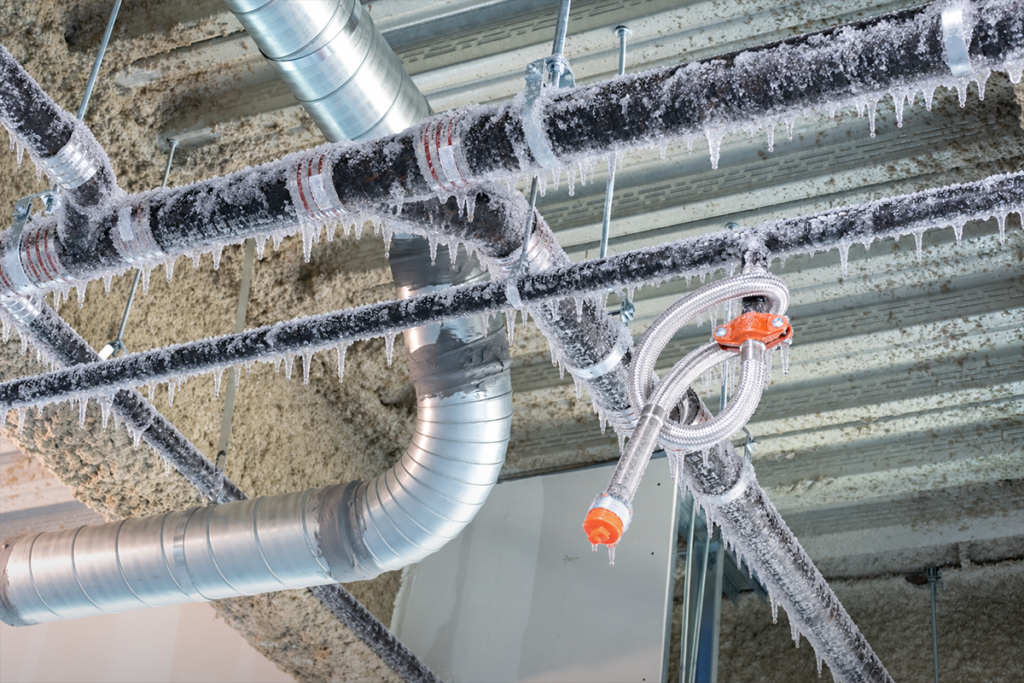
A frozen fire sprinkler pipe is a section of water-filled sprinkler piping where ice has formed and blocked the line. The ice isn’t what breaks it. As the ice keeps growing, it squeezes the water trapped behind it until the pipe or a fitting splits, often in a spot with little or no ice. The leak usually shows up later, when the ice thaws and water starts to flow.
Quick facts
- Pipes split where the ice isn’t. Pressure builds in the water trapped between an ice blockage and a closed fitting. That’s where the break usually happens.
- The thaw is when it floods. Insurers note burst pipes often go unnoticed until the ice melts and water starts moving.
- 40°F is the line. Wet-pipe sprinkler areas need to stay at 40°F or warmer. Spaces that can’t usually get a dry-pipe or antifreeze system instead.
- Cold spots are predictable. Attics, loading docks, stairwells, vestibules, riser rooms, fire pump test headers and pipe in exterior walls top the insurer lists.
- Dry systems freeze too. Water left sitting in low points freezes and splits fittings.
- Confirm it isn’t a fire first. Then close the valve and call the fire department, your alarm company and your insurer.
- Texas learned this the hard way. Engineering firms that worked the February 2021 recovery reported frozen and burst wet-pipe sprinkler systems and backflow preventers as common failures.
The 2 a.m. call: an illustrative scenario
This is a composite, not a real customer. It’s how these nights tend to go.
A dock door doesn’t close all the way on Friday. The weekend drops into the teens. A branch line over the dock freezes, and the water trapped behind the ice splits an elbow. Nothing leaks yet. The ice is holding it.
Sunday afternoon the sun comes out. The ice lets go. At 2 a.m. Monday, water pours out of that split fitting onto pallets of product, the waterflow alarm trips, and the property manager’s phone lights up.
Nobody did anything crazy. A door stayed open. That’s usually all it takes.
Why a frozen fire sprinkler pipe bursts
Most people picture ice swelling and bursting the pipe like a balloon. That’s not quite it.
Research from the University of Illinois Building Research Council found that a pipe first forms an ice blockage. As more ice forms, it pushes against the water trapped behind it, between the blockage and a closed sprinkler or fitting. That trapped water has nowhere to go, and the pressure climbs until something gives. The ICC, citing the Insurance Institute for Business and Home Safety, says the pipe often bursts where little or no ice has formed.
In sprinkler piping, elbows and threaded joints are often the weak points, according to a former FM Global loss examiner writing in Fire Engineering. Pipe that isn’t pitched right can trap condensate that freezes, too.
That’s also why the damage hides. A split fitting can sit quietly for days while the ice holds. It floods when the building warms up, often when nobody’s there.
Where sprinkler pipes freeze in commercial buildings
Insurers and fire marshals keep naming the same spots:
- Loading docks and the pipe over overhead doors
- Attics, roof spaces and concealed space above ceilings
- Stairwells, vestibules and entryways near exterior doors
- Riser rooms and dry-pipe valve rooms that lose heat
- Fire pump test headers and exposed pipe on outside walls
- Warehouses and isolated storage with little heat
- Skylights and poorly insulated areas
- Low points on dry systems where water collects
If your building has any of these, it’s worth walking them with our fire sprinkler winterization checklist before the first hard freeze.
What to do in the first hour
When a frozen pipe lets go, the first hour decides how bad the damage gets. Here’s the order insurers and loss examiners recommend.
Make sure it isn’t a fire
Water flowing from a sprinkler system means one of two things. Close a valve only once you’re sure the water’s coming from a broken pipe and not an open head over a fire.
Shut it down and drain it
Close the control valve for the affected system and open the main drain to take the pressure off. If your system has sectional valves, isolate just the damaged area and keep the rest of the building protected.
Make the calls
Notify the fire department and fire official, your alarm monitoring company and your insurer. Insurers want to hear about any impairment as soon as possible.
Start a fire watch and tag the system
Part of your building just lost its protection. Tag the system as out of service and set up a fire watch. Your fire official sets the details. Our guide to fire watch requirements covers who can stand watch, how often to patrol and what to log.
Stop hot work
No welding, cutting or open flames in the affected area until the system’s back.
Document everything
Photograph the damage and the failed fitting. Keep the parts that come out. Insurers may want to see them.
Get it repaired and restored
The fire watch ends when the system works again, not when the water stops. Our fire sprinkler repair team replaces the damaged pipe, tests the system and documents the restore.
What the 2021 Texas freeze taught Houston
In February 2021, a winter storm, often called Winter Storm Uri, drove temperatures across Texas far below what most buildings there were built for. More than 4 million homes and businesses lost power, according to AccuWeather. Houston Public Works estimated that about a quarter of its water customers had a leak, based on meter data reported by the Houston Chronicle.
Sprinkler systems took a beating. Engineering firms that worked the recovery reported frozen and burst wet-pipe systems and frozen backflow preventers as common failures. In Killeen, the fire department said a hotel’s sprinklers were out of service because of frozen pipes when the building caught fire, with all 102 rooms occupied.
The lesson isn’t only for Houston. Memphis, Nashville and Arkansas get hard freezes too. A building that rarely sees single digits is a building that rarely plans for them.
How to keep a frozen fire sprinkler pipe from happening
Insurer checklists from Travelers, Zurich and FM Global line up on the basics:
- Keep the heat on. Hold every wet-pipe area at 40°F or warmer, including riser rooms, pump rooms and dry-valve rooms. Service the heat before the season starts.
- Watch the temperature. Put low-temperature monitoring or thermometers in known cold spots.
- Seal and insulate. Close gaps at doors, windows and vents. Use listed heat tracing and insulation on exposed lines.
- Drain dry system low points. Before freezing weather and after any trip or test. Our guide on dry system low point drains shows how.
- Check your antifreeze. If you’ve got antifreeze loops, test the solution. Here’s what NFPA now requires for antifreeze systems.
- Check valve enclosures. NFPA 25 calls for daily checks of heated valve enclosures during cold weather, or weekly when a low-temperature alarm is installed.
- Plan for a heat failure. Decide now who checks the building during a freeze and what they do if the heat goes out.
Pipe split tonight? Call us and we’ll start on the repair. Rather skip the 2 a.m. call? Let’s walk your building before the freeze.
Frequently asked questions
At what temperature do fire sprinkler pipes freeze?
There’s no single number, because it depends on insulation, wind and how long the cold lasts. The Insurance Institute for Business and Home Safety says unprotected pipes generally start to freeze when it’s 20°F outside. Wet-pipe sprinkler areas should be kept at 40°F or warmer.
What should I do if a frozen sprinkler pipe bursts?
Confirm the water isn’t from a fire, then close the control valve and open the main drain. Notify the fire department, your alarm company and your insurer. Tag the system, start a fire watch if required, stop hot work, document the damage and get the system repaired and tested.
Can dry sprinkler systems freeze?
Yes. Water left in low points and condensation in the piping can freeze and split fittings. Draining low points before freezing weather and after any trip or test, plus keeping the dry-pipe valve room heated, are the main defenses.
Do I need a fire watch after a sprinkler pipe bursts?
Often, yes. Once the system is shut down, the building is impaired. The fire official decides when a fire watch is required, and NFPA 25 calls for extra measures, such as a fire watch, when a system is out more than 10 hours in a 24 hour period.
How do I prevent frozen sprinkler pipes?
Keep wet-pipe areas at 40°F or warmer, monitor known cold spots, seal and insulate openings, drain dry system low points, test antifreeze solutions and check heated valve enclosures during cold weather. Inspect the system before the first hard freeze.