
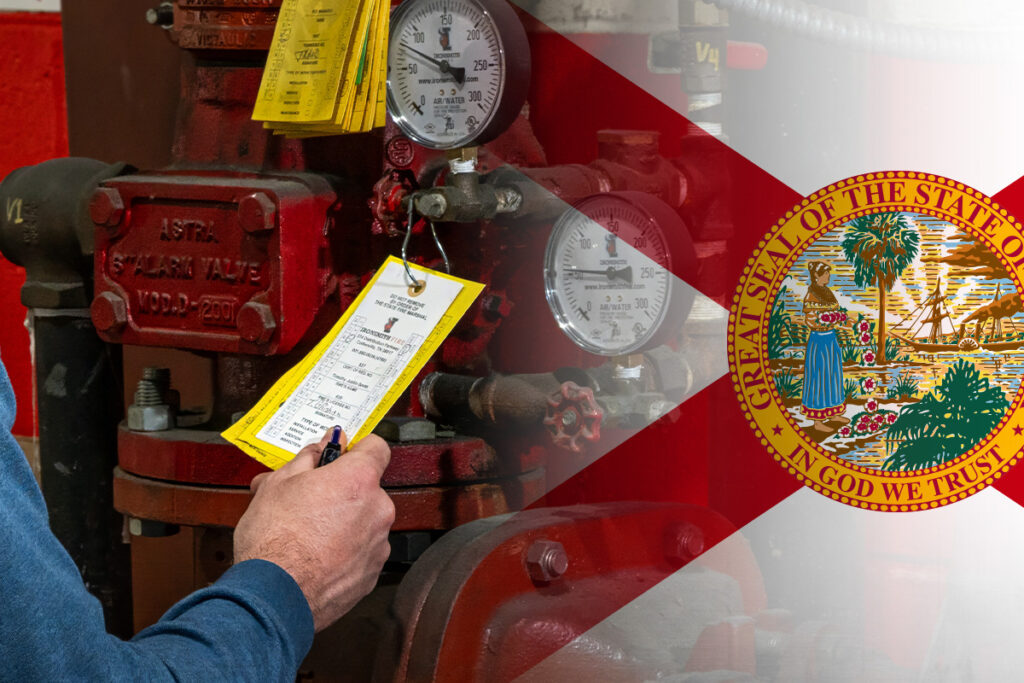
FLORIDA COMPLIANCE
By the Ironsmith Fire Engineering Team · Florida · Orlando
Florida fire sprinkler inspection requirements come from state law and the Florida Fire Prevention Code. Sprinkler systems in commercial buildings and condos must be inspected, tested and maintained to NFPA 25, in the edition the State Fire Marshal adopts. A licensed fire protection contractor, or a permitted inspector the contractor employs, does the work. The contractor sends a summary report to the owner and the local fire authority. Fixing what’s found is the owner’s job.
Quick facts
- The rulebook is the Florida Fire Prevention Code. The 8th Edition has been in effect since December 31, 2023. It’s built on the Florida editions of NFPA 1 and NFPA 101.
- A new edition lands December 31, 2026. The State Fire Marshal’s proposed rule for the 9th Edition moves NFPA 25 from the 2020 edition to the 2023 edition.
- Only licensed people can inspect. That means a Contractor I or II, or a permitted Water-Based Fire Protection Inspector working for one.
- The report goes to two places. You get a copy. So does your local fire authority.
- Deficiencies get sorted. The summary report splits them into critical and noncritical, and describes any impairments.
- A milestone inspection isn’t a sprinkler inspection. Condo milestone inspections look at structure. They don’t test your fire protection.
- The owner owns the fix. Florida law puts maintenance and corrective action on the system owner.
Florida fire sprinkler inspection requirements start with state law
Florida doesn’t leave sprinkler inspections to local habit. Section 633.312 of the Florida Statutes requires fire protection systems in public and private buildings, other than one and two family homes, to be inspected under NFPA 25 and NFPA 24, in the editions the State Fire Marshal adopts. Local fire officials enforce it, and some counties add local amendments to the fire code.
The statute also names the rhythm. Inspections happen quarterly, annually, every three years and every five years, in line with the owner’s contract. Our NFPA 25 inspection schedule shows which tasks fall in which window.
Which edition applies today
Under the current 8th Edition of the Florida Fire Prevention Code, the State Fire Marshal’s rules adopt the 2020 edition of NFPA 25. The 9th Edition takes effect December 31, 2026, and the proposed rule moves to the 2023 edition of NFPA 25.
If your next inspection falls after that date, ask your contractor which edition the report will follow.
Who’s allowed to inspect your system
In Florida, sprinkler inspections are done by the licensed fire protection contractor or by employees who hold a state permit to inspect. That permit is called a Water-Based Fire Protection Inspector permit, and it’s only valid while the holder works for the contractor named on it.
You don’t have to take anyone’s word for it. Florida’s rules require a record tag on the riser after every inspection, test or maintenance visit. The tag shows the contractor’s name and license number, the inspector’s permit number and signature, and the punched date. Our guide to inspection tags covers what Florida’s tags look like and what each one means.
What you get after a Florida inspection
The uniform summary inspection report
Florida requires a uniform summary inspection report for every inspection. It records:
- Where. The address of the system.
- Who. The company and person who inspected it, with their license number.
- When. The inspection date.
- What was found. The total number of deficiencies, split into critical and noncritical, plus a short description of any impairments.
The contractor gives a copy to you and to the local authority having jurisdiction. Local fire officials can accept it by mail, hand delivery, electronic submission or a third-party vendor.
The detailed report
You should also get a detailed inspection report. It doesn’t have to follow the summary format. It’s the working document: every device checked, every test run and every result. Keep it. It’s the record you’ll need when a fire marshal, insurer or buyer asks.
Condos: what’s different
Milestone inspections are structural
After the Surfside collapse, Florida passed SB 4-D in 2022 and revised it with SB 154 in 2023. Condo and co-op buildings three stories or taller now need a milestone inspection of their structure by an architect or engineer at 30 years and every 10 years after.
That inspection looks at load-bearing structure. It doesn’t test your sprinkler system. Passing your milestone inspection says nothing about whether your fire pump starts or your control valves are open.
The reserve study does include fire protection
The same laws require a structural integrity reserve study every 10 years for buildings three stories or taller. Fireproofing and fire protection systems are on the required list. The study is based on a visual inspection and is about funding repairs and replacement. It isn’t an NFPA 25 test either.
Here’s where the two meet. Your NFPA 25 reports show the real condition of your sprinkler system. Hand them to whoever prepares your reserve study, so the fire protection numbers reflect what’s actually in the building.
High-rise retrofit
Florida’s fire code requires existing residential high-rises, where an occupied floor sits more than 75 feet above fire department vehicle access, to have full sprinkler protection or an approved engineered life safety system. The legislature has moved the deadlines and opt-out rules several times. If your association hasn’t closed this out, talk to your local fire official and a fire protection engineer now.
Commercial buildings: what to watch
- Know who owns the system. If you lease, your lease should say who schedules inspections and who pays for repairs. If it’s silent, ask before the first deficiency shows up.
- Watch for changes in use. New tenants, taller storage and new walls can change what your sprinkler system has to protect. Your inspector should flag them.
- Plan for impairments. If a system has to come out of service, have a plan for fire watch before it happens.
- Close out deficiencies fast. A critical deficiency on a report sent to the fire marshal is a clock, not a suggestion.
New to the terms? Our explainer on inspection, testing and maintenance covers the basics.
Orlando and Central Florida
Our Orlando team handles NFPA 25 inspections across Central Florida. Your local fire marshal’s office is still the final word on how reports get filed in your city or county, so confirm their submission method with them.
Need a licensed Florida inspection with the reports filed right?
Frequently asked questions
How often do fire sprinkler systems need to be inspected in Florida?
Florida law requires sprinkler systems to be inspected under NFPA 25, with inspections quarterly, annually, every three years and every five years, in line with the owner’s contract. The exact tasks in each window depend on your system type. Your contractor’s report should state the interval for each item.
Who can inspect fire sprinkler systems in Florida?
A licensed Fire Protection Contractor I or II, or an employee holding a state Water-Based Fire Protection Inspector permit. The permit is only valid while the holder works for the contractor named on it. The tag on your riser shows the contractor’s license number and the inspector’s permit number.
Does a condo milestone inspection include the fire sprinkler system?
No. A Florida milestone inspection is a structural inspection by an architect or engineer. It doesn’t test sprinklers, pumps or valves. Your sprinkler system still needs its NFPA 25 inspections. The separate structural integrity reserve study does include fire protection systems, but only for reserve funding, based on a visual inspection.
What edition of NFPA 25 does Florida use?
Under the 8th Edition of the Florida Fire Prevention Code, the State Fire Marshal’s rules adopt the 2020 edition of NFPA 25. The 9th Edition takes effect December 31, 2026, and the proposed rule moves to the 2023 edition. Ask your contractor which edition your reports follow.
Who is responsible for fixing sprinkler deficiencies in Florida?
The owner. Section 633.312 of the Florida Statutes makes the owner of the system responsible for maintenance and for corrective action on deficient systems. The inspecting contractor reports what’s found to you and to the local fire authority. Getting it fixed is on you.