
CAREERS IN THE TRADE
By the Ironsmith Fire Team · Memphis · Nashville · Orlando · Houston · Little Rock
A sprinkler fitter installs, tests, services, and repairs the water-based fire protection systems in commercial buildings. The work splits into two lanes: install, which happens on construction sites off drawings, and inspection, testing, and maintenance, which keeps existing systems proven and documented. You do not need a college degree to get in. Most people learn through a paid apprenticeship.
Quick facts
- Education needed: high school diploma or equivalent, per the Bureau of Labor Statistics
- How you learn it: a four or five year paid apprenticeship, according to BLS
- What it pays: BLS does not break out sprinkler fitters. The median for plumbers, pipefitters, and steamfitters was $62,970 in May 2024
- The two standards you will live in: NFPA 13 for installation, NFPA 25 for inspection, testing, and maintenance
- The credential that travels: NICET certification, with separate tracks for layout and for inspection and testing
- Why the trade is open: construction needs to attract 349,000 net new workers in 2026, and most people have never heard of this job
Most people have never met a sprinkler fitter. They have stood under the work a thousand times.
Every commercial building you have ever walked into, the hospital, the distribution center, the high school gym, the data center, has a network of pipe overhead that exists for one moment that will probably never come. Somebody laid that pipe out. Somebody cut it, threaded it, hung it, pressure-tested it, and signed the paperwork. Somebody comes back every year to prove it still works.
That is the job. Here is what it actually involves, what it takes to get in, and why there is more work than there are people to do it.
What a sprinkler fitter does all day
A sprinkler fitter installs, tests, services, and repairs the water-based fire protection systems in commercial buildings. Two very different kinds of days sit under that one title, and knowing the difference matters before you pick a lane.
Install work: you are on a construction site
Install is new construction and renovation. You are on a jobsite with the other trades, working off drawings, putting a system in a building that does not have one yet.
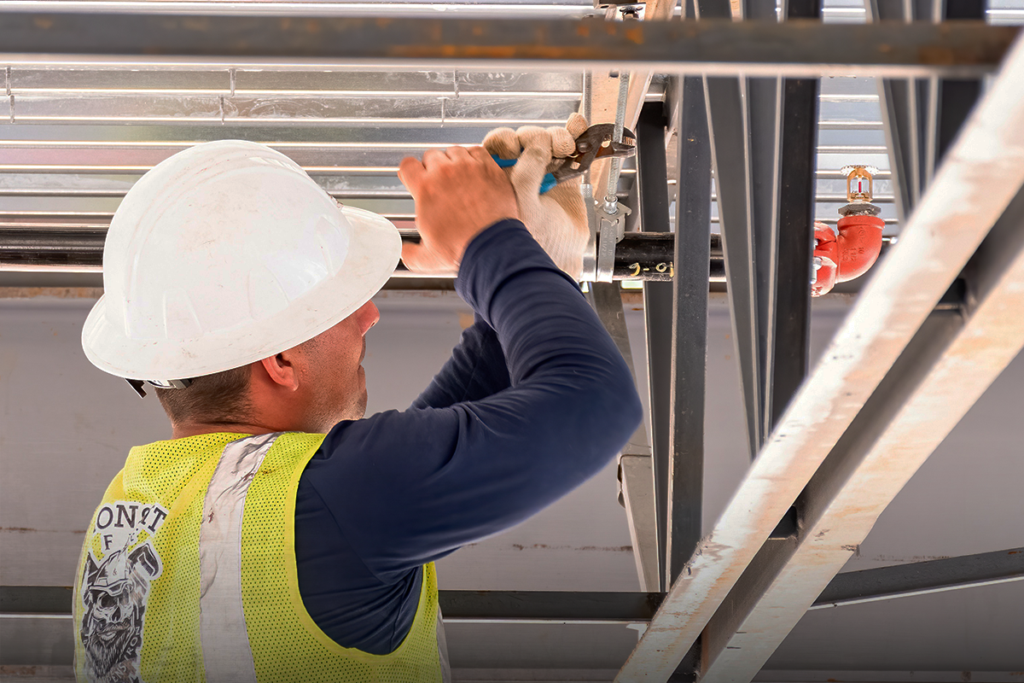
The day looks like this. Reading the layout drawings and knowing where your pipe is supposed to run. Measuring. Cutting and threading steel, or working CPVC. Hanging pipe overhead, off ladders, off lifts, off scaffolding. Setting risers. Installing heads, valves, and backflow devices. Coordinating with the electricians and the mechanical crew when everybody wants the same six inches of ceiling space. Then hydrostatic testing the system and walking it with the inspector until it passes.
The standard that governs all of it is NFPA 13, the Standard for the Installation of Sprinkler Systems. It is the rulebook for how a system gets put in, and you will learn it on the job whether you plan to or not. If you want to see the finished product, that is our sprinkler installation work.
Service and ITM work: you are the one who proves it works
The other lane is inspection, testing, and maintenance, known as ITM. Installed systems have to be checked on a schedule, forever. That schedule comes from NFPA 25, the Standard for the Inspection, Testing, and Maintenance of Water-Based Fire Protection Systems. If you want the owner-facing version, we broke down the NFPA 25 inspection schedule separately.
An ITM day looks nothing like an install day. You are in a truck, hitting multiple buildings. You are running flow tests on the inspector’s test connection, checking gauges and valve positions, trip-testing dry systems, looking for corrosion and obstruction, replacing heads that have been painted over or knocked loose. You are talking to the building’s maintenance guy, and often to the fire marshal. And you are writing it all up, because in this trade an inspection with no documentation is an inspection that did not happen.
If install is building the thing, ITM is being the person who can say, with a signature on it, that the thing still works.
The fab shop: the part nobody expects
There is a third piece most people outside the trade have never heard of: fabrication. Instead of every cut and every thread happening overhead on a ladder, pipe gets cut, grooved, threaded, and welded to spec in a shop, then shipped to the site ready to hang.
Ironsmith Fire runs its own fabrication shop in La Vergne, Tennessee. That matters to a fitter for a practical reason: fab work is a real career path inside this trade, and shop-fabricated pipe makes field days go faster and cleaner.
The trade is short-handed, and that is the opportunity
Here is the honest version of the labor market, with sources.
Construction as a whole needs to attract 349,000 net new workers in 2026 on top of normal hiring, and 456,000 in 2027, according to Associated Builders and Contractors’ January 2026 workforce model. Roughly one-fifth of electricians are already over 55, and the same demographic curve runs through every trade.
Inside fire protection specifically, an NFPA industry survey reported by EHS Today found that half of skilled tradespeople named a shortage of qualified candidates as their single biggest obstacle, with retirement and retention each cited by 31 percent.
And then there is the reason the shortage persists: almost nobody knows the job exists. A September 2025 consumer survey commissioned by Classic Fire and Life Safety found only 22 percent of respondents were familiar with sprinkler fitters, and just 11 percent knew where to start pursuing a fire protection trade career. That survey polled Canadian adults, so treat it as directional rather than a US figure, but the pattern will not surprise anyone in this industry.
Put those together. Steady demand driven by codes that require fire suppression in commercial buildings. A retiring workforce. And a pipeline of new people that is thin mostly because the trade is invisible.
That is not a problem for you. That is leverage.
How you actually get into the trade
You do not need a college degree
The Bureau of Labor Statistics lists the typical entry-level education for this occupation as a high school diploma or equivalent. Not an associate’s. Not a bachelor’s. No tuition debt.
What you need is the ability to show up, work with your hands, take direction, learn to read a drawing, and be someone a foreman trusts on a lift.
Apprenticeship: get paid while you learn
The standard path in is an apprenticeship. BLS reports most plumbers, pipefitters, and steamfitters learn the trade through a four or five year apprenticeship: full-time paid work alongside classroom instruction.
In the Department of Labor’s own words, a registered apprenticeship is a career pathway where individuals obtain paid work experience with a mentor, receive progressive wage increases and classroom instruction, and earn a portable, nationally recognized credential. You earn a wage from day one, get raises as you hit skill milestones, and finish with something that travels. Start at apprenticeship.gov if you want to see what is registered near you.
Compare that to the four-year-degree math and it is a different financial life.
Certifications and licensing
NICET certification is the credential the industry recognizes. There are separate NICET programs for water-based systems layout, which is the design side, and for inspection and testing of water-based systems. The ITM track runs three levels, from working under direct supervision at Level I up to running complex work and supervising others at Level III. Recertification comes every three years.
Licensing varies by state. Most states license the fire sprinkler contractor. Requirements for individual fitters, registration, and journeyman status differ from state to state. Check your state’s requirements, and do not assume what applies in Tennessee applies in Texas.
What it pays
Be careful with numbers you find online, including ours. BLS does not publish a separate wage for sprinkler fitters. It groups them into plumbers, pipefitters, and steamfitters, where the median annual wage was $62,970 in May 2024. Roughly 44,000 openings in that occupation are projected each year over the 2024 to 2034 decade.
Treat that as the neighborhood, not the number. Real pay depends on your market, your lane, your certifications, overtime, and whether you top out as a fitter or move into layout, foreman, or project management work. If you want our actual ranges, ask us in the interview. We will tell you straight.
Where Ironsmith Fire fits
We are a commercial fire sprinkler and suppression contractor with crews out of Memphis, Nashville, Orlando, Houston, and, as of this month, Little Rock, covering all of Arkansas out of our Jacksonville office. Our fab shop in La Vergne is ours. Our field crews are ours. And we are hiring across all five markets.
Here is the part that is hard to put on a benefits sheet. This industry is being bought up by private equity roll-ups. When that happens, the person who decides how your crew gets run is three layers and one state away, and you become a number on a utilization report.
Ironsmith Fire is run by the people whose name is on it, and they are in the business every day. Our branch managers came up in this work. Our newest branch manager in Little Rock came from a competitor and is building that market from the ground up. The owners know the crews’ names. That is not a slogan. It is the actual difference between the two kinds of companies you can work for in this trade, and you will feel it in the first month.
If you have never touched pipe, that is fine. Per our careers page, we hire apprentices and entry-level field hands and train on the job, with an apprentice path and mentorship on the install side. If you are already a fitter with a few years and a truck full of tools, that is a different conversation and a faster one.
Either way, the trade has more work than people right now. That window does not stay open forever.
Ready to get in? We are hiring across Memphis, Nashville, Orlando, Houston, and Little Rock. Apprentices and entry-level field hands included. We train on the job.
Frequently asked questions
What does a sprinkler fitter do?
A sprinkler fitter installs, tests, services, and repairs water-based fire protection systems in commercial buildings. Install work happens on construction sites: reading drawings, cutting and threading pipe, hanging it overhead, setting valves and heads, then pressure-testing the system. Service and ITM work means inspecting and testing systems that are already in service, on the schedule set by NFPA 25, and documenting the results.
Do you need a college degree to become a sprinkler fitter?
No. The Bureau of Labor Statistics lists a high school diploma or equivalent as the typical entry-level education for plumbers, pipefitters, and steamfitters, the occupation group that includes sprinkler fitters. Most people learn the trade through a paid apprenticeship instead of a degree program.
How long is a sprinkler fitter apprenticeship?
BLS reports that most plumbers, pipefitters, and steamfitters learn the trade through a four or five year apprenticeship. Registered apprenticeships pay you from day one, combine on-the-job training with classroom instruction, include progressive wage increases as you gain skills, and end in a nationally portable credential.
How much does a sprinkler fitter make?
BLS does not publish a wage specifically for sprinkler fitters. It includes them in plumbers, pipefitters, and steamfitters, where the median annual wage was $62,970 in May 2024. Actual pay varies by market, specialty, certification level, and overtime, so use that figure as a reference point rather than a quote.
What is the difference between NFPA 13 and NFPA 25?
NFPA 13 is the Standard for the Installation of Sprinkler Systems, and it governs how a system is put in. NFPA 25 is the Standard for the Inspection, Testing, and Maintenance of Water-Based Fire Protection Systems, and it governs what has to happen to that system for the rest of its life. Install crews live in NFPA 13. ITM technicians live in NFPA 25.