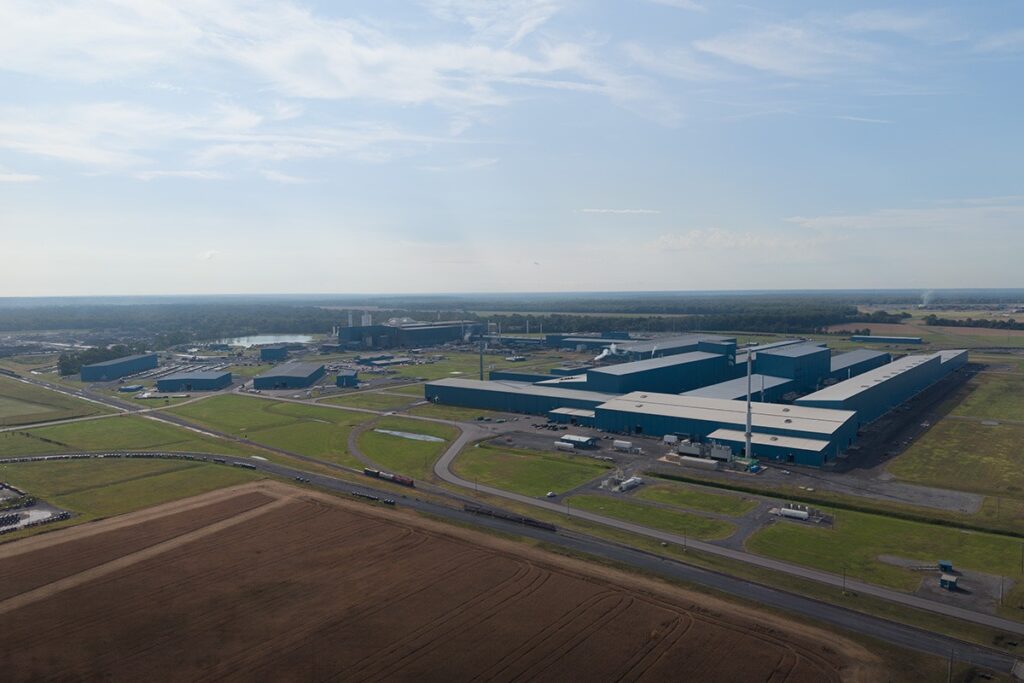
Location: Osceola, AR
Owner: Big River Steel
Project Area: PGL Pickling Line, Cold Mill
Scope: 5 Deluge Systems, 2 Wet Pipe Sprinkler Systems, Linear Heat Detection, Automatic Deluge Valves, Corrosion-Resistant Piping and Nozzles
Fire Protection Built for an Acid Line
A steel mill’s pickling line is one of the harshest places you can hang pipe. The line runs steel through acid to strip scale off the surface, and the air around it eats metal. Standard sprinkler pipe and heads don’t last long there. And when the hazard is that high, waiting for one sprinkler at a time to open isn’t good enough.
At Big River Steel’s PGL Pickling Line in the Cold Mill, Ironsmith Fire designed and installed steel mill fire protection built for exactly that environment: five deluge systems, two wet pipe systems, the detection that fires them and the valves that open them.
The Challenge
- A corrosive atmosphere. The air around the line is extremely corrosive. Bare steel and standard heads were off the table.
- A high-hazard industrial process. The area was designed as Extra Hazard Group I, a big step up from the ordinary hazard classes most buildings use.
- Fire inside the ductwork. The line’s fiberglass ductwork needed protection on the inside, where rigid pipe and standard heads don’t belong.
- Water has to arrive everywhere at once. A deluge system opens every nozzle in its zone together. That only works if detection is fast and the valves open on their own.
Our Solution
- Fought corrosion at every layer. Schedule 40 black steel pipe and fittings, powder coated red, with added steps in the design to cut corrosion in the acid environment.
- Specified nozzles made for the fumes. Halar nozzles fitted with rubber plugs in the orifice, so the corrosive atmosphere stays out until the system discharges.
- Protected the inside of the ductwork. Nozzles inside the fiberglass ducts mount on flexible, non-corrosive hydraulic hoses instead of rigid pipe.
- Built deluge for speed. Five deluge systems, each with automatic-opening Bray butterfly valves actuated by a dedicated half-inch air line.
- Tied it to detection. Linear heat detection modules and Detect-A-Fire heat detectors trigger the deluge valves without anyone in the loop.
- Designed for the hazard. Extra Hazard Group I at 0.30 GPM per square foot over the most remote 3,500 square feet, with 500 GPM for outside hose.
Scope of Work
Design
- Shop drawings and submittals for the pickling line systems
- Hydraulic calculations for Extra Hazard Group I
- Design documents signed by our Responsible Managing Employee
Deluge and wet pipe systems
- Five deluge systems and two wet pipe sprinkler systems in the PGL Pickling Line
- Schedule 40 black steel pipe and fittings, powder coated red
- Halar nozzles with rubber orifice plugs
- Nozzles in the fiberglass ductwork installed on flexible, non-corrosive hydraulic hoses
- Extra Hazard Group I design: 0.30 GPM per square foot over the most remote 3,500 square feet, with 500 GPM outside hose allowance
Valves and detection
- Automatic-opening Bray butterfly valves with stands
- Half-inch air line to actuate the valves
- Linear heat detection modules
- Detect-A-Fire heat detectors
By the Numbers
- 5 deluge systems
- 2 wet pipe sprinkler systems
- 3,500 square foot design area at 0.30 GPM per square foot
- 500 GPM outside hose allowance
- 1 accountable team for pipe, nozzles, valves and detection
Why Ironsmith Fire?
Deluge piping, corrosion-resistant nozzles, automatic valves and heat detection usually come from different trades, and in a pickling line every one of them has to work the first time. Here they came from one team. That means one call, one accountable team, and no finger-pointing between vendors. It’s what we mean by full-service fire protection.
See how we protect industrial and manufacturing facilities, read about our corrosion protection work, or look at another heavy industrial project at Hankook Tire.
Running a process line that’s hard on pipe? Let’s engineer protection that lasts.